10+ Years ExperienceInsured
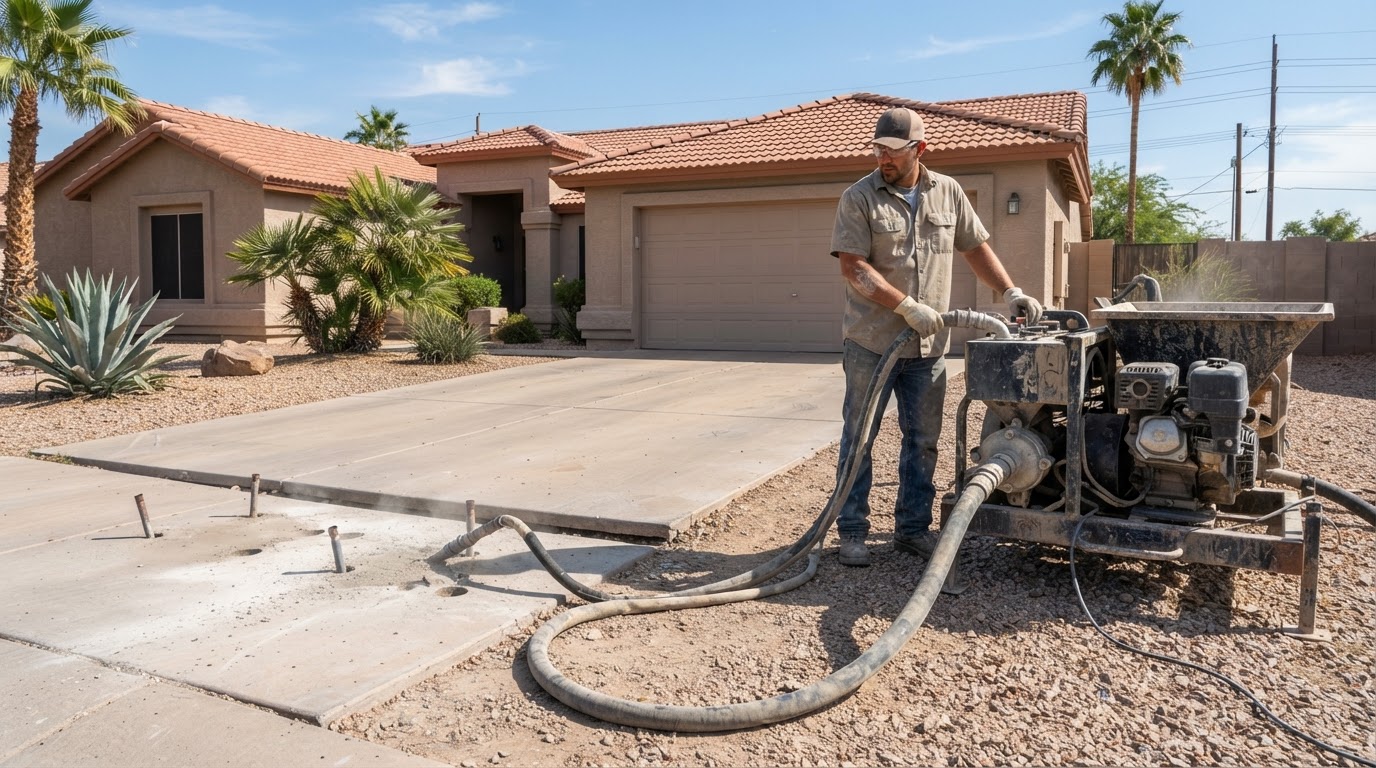
Mudjacking cement slurry concrete raising at a residential slab in Gilbert, Arizona

10+ Years Experience · Insured

Mudjacking in Gilbert, AZ | 10+ Years Experience

An established concrete raising method that pumps a cementitious slurry beneath settled slabs to fill voids and lift the concrete — a proven, economical option where the slab and project conditions fit.

Request an Estimate

Tell us about your project. We'll follow up with clear pricing and next steps.

The customer/project address for the work.


Consent is optional. You may request an estimate without opting in to text messages.

Mudjacking is an established concrete lifting method that uses a cementitious slurry material introduced beneath suitable slabs to raise and support selected concrete flatwork where project conditions fit the method. The slurry — a grout of cement and fine aggregate — is pumped under pressure through access holes in the slab to fill voids and lift the concrete back toward its original elevation. Traditional mudjacking generally uses larger access openings and a heavier material than polyurethane foam lifting, but the heavier slurry is not automatically worse; it is a method-selection factor weighed against slab condition, voiding, access, lift requirement, soil and subgrade conditions, and project economics. Mudjacking is not claimed to be always cheaper or always longer-lasting than other methods — it is one proven option among several. See our concrete leveling methods comparison or the homepage overview for the broader context.

This page is distinct from our polyjacking page because the material, access-hole size, weight, and return-to-use characteristics of a cementitious slurry are materially different from expanding polyurethane foam. Mudjacking suits some slabs and project conditions better than foam, and foam suits others better than slurry — the right recommendation comes from inspecting the actual slab. When concrete is severely broken, extensively cracked, or deteriorated, replacement may be more appropriate than any lifting method, and mudjacking does not repair a building's structural foundation. With 10+ years of experience and insured service, Gilbert Concrete Leveling evaluates whether mudjacking fits your slab and explains the repair-vs-replacement tradeoff honestly, without attacking polyjacking or declaring a universal winner.

Why Choose Gilbert Concrete Leveling for Mudjacking in Gilbert?

Mudjacking is a proven method, but it fits some slabs better than others. Our role is to inspect the concrete first and recommend slurry-based lifting only where the conditions support it.

  • 10+ Years of Experience

    A decade of selecting between mudjacking, polyurethane foam, and void filling based on what each slab, void, and access situation actually requires.

  • Insured

    Gilbert Concrete Leveling is insured for the mudjacking and concrete raising work we perform on your property.

  • Understanding of Traditional Slurry-Based Lifting

    Hands-on experience with cementitious slurry methods — how the grout flows, fills voids, and lifts a suitable slab under controlled pressure.

  • Multiple Method Options

    We are not locked to mudjacking alone. When polyurethane foam or void filling better fits the slab, we recommend that instead.

  • Project-Specific Repair Recommendations

    The method is chosen after inspecting slab condition, settlement pattern, void size, and access — not before.

  • Slab-Condition Evaluation

    We confirm the slab is intact enough to be lifted as a unit before recommending mudjacking, because unsound concrete cannot be reliably raised.

  • Transparent Process and Cost Explanation

    Pricing is explained by the factors that drive it — panels, square footage, lift, slurry volume, and access — and the process is laid out plainly.

  • Repair-vs-Replacement Guidance

    When a slab is too deteriorated for slurry lifting, you get an honest recommendation for replacement instead of a repair that will not hold.

Our Mudjacking and Concrete Raising Services

Each application below uses a cementitious slurry to fill voids and lift a specific type of settled concrete where the slab is still sound enough to raise.

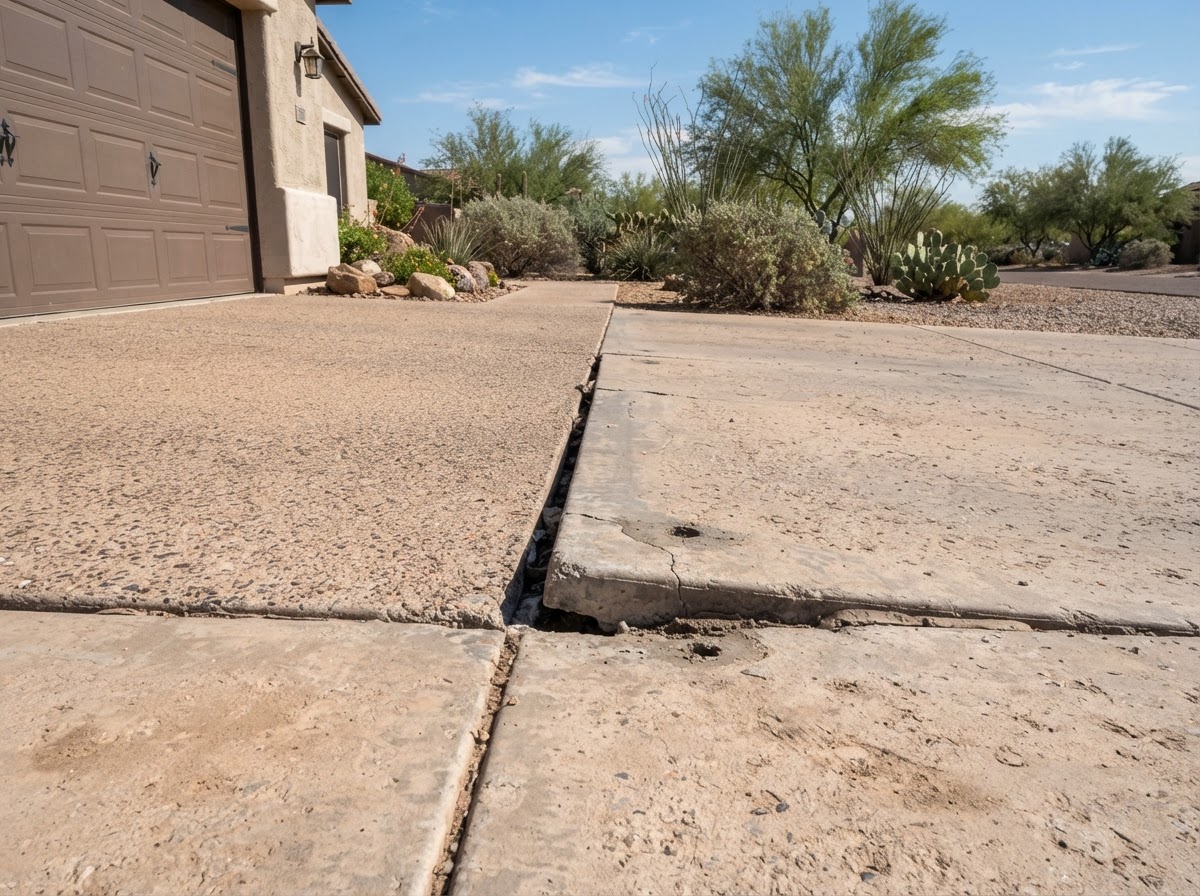
Settled concrete driveway panels with a height offset at the expansion joint

Driveway Mudjacking

Driveway mudjacking raises settled driveway panels back toward the adjacent surface, particularly where a panel has dropped at the garage approach or between adjoining sections. It applies to Gilbert driveways where the panels are intact but have lost elevation or support.

Cementitious slurry is pumped through access holes at lift points beneath the settled panels to fill the void and raise the concrete, with attention to the garage transition, the surface slope, and the control and expansion joints between panels.

The result is a smoother, more even driveway with a reduced transition lip and improved drainage, achieved with a proven slurry method that preserves the existing concrete instead of replacing it.
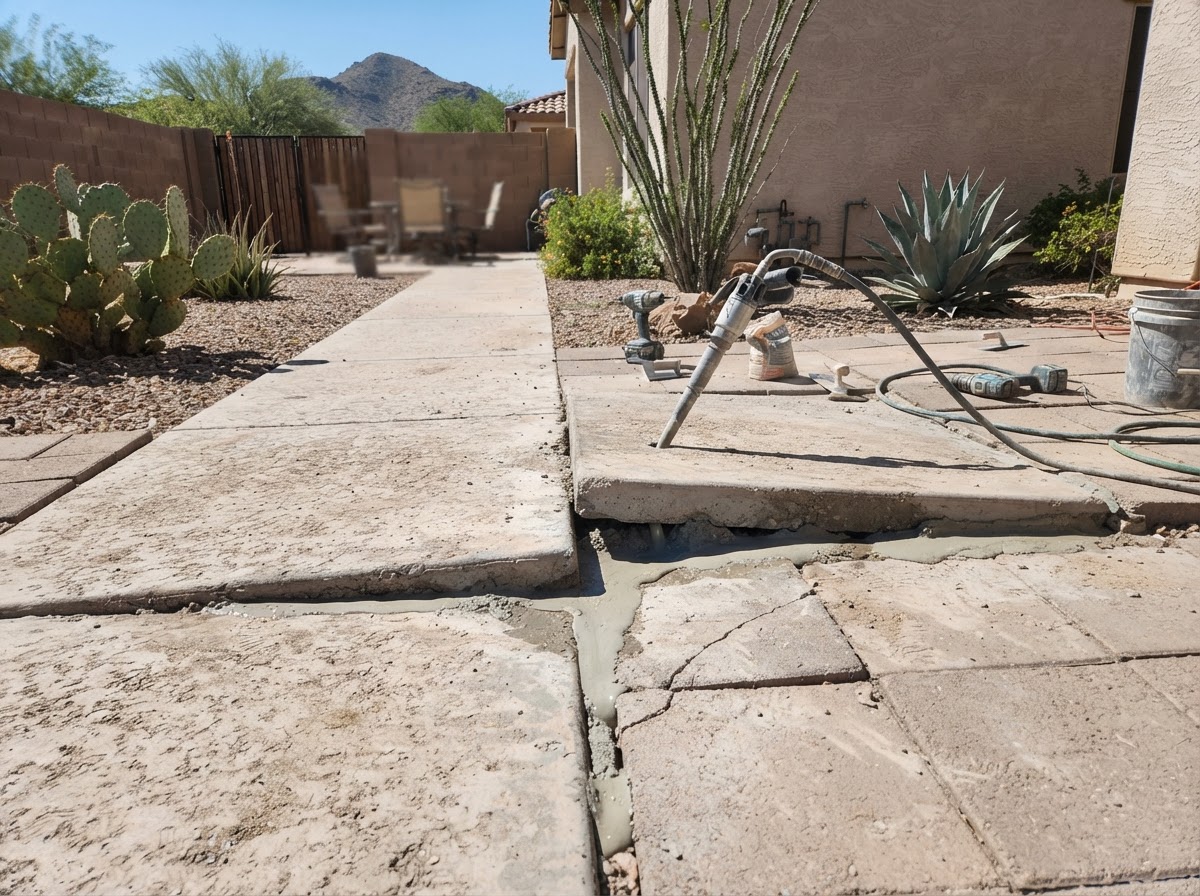
Concrete sidewalk and patio panels with uneven settlement at the joints

Sidewalk Mudjacking

Sidewalk mudjacking lifts a sidewalk panel that has settled below its neighbor, removing the trip hazard that forms at the joint between the two panels. It is used on pedestrian walks where the concrete is intact but one section has dropped.

Cementitious slurry is pumped through access holes beneath the lower panel to fill the void and raise the concrete back into alignment, restoring an even joint line and a continuous walking surface.

The outcome is a safer pedestrian path with the trip transition reduced at the joint, preserving the existing sidewalk panel instead of cutting and repouring the section.

Settled patio slab with uneven elevation in an Arizona residential yard

Patio and Walkway Mudjacking

Patio and walkway mudjacking lifts settled exterior flatwork near doors, paths, and landscaped areas where a slab has dropped at a corner or edge. It applies to patios and walkways that are intact but have tilted, lost support, or developed a low spot.

Cementitious slurry is introduced beneath the settled area to fill the void and bring the surface back toward level, with attention to how the patio or walkway drains away from the home and the transitions to adjoining surfaces.

The outcome is a flatter, more usable outdoor surface with improved drainage and a reduced trip edge, keeping the existing patio or walkway slab in place rather than replacing it.

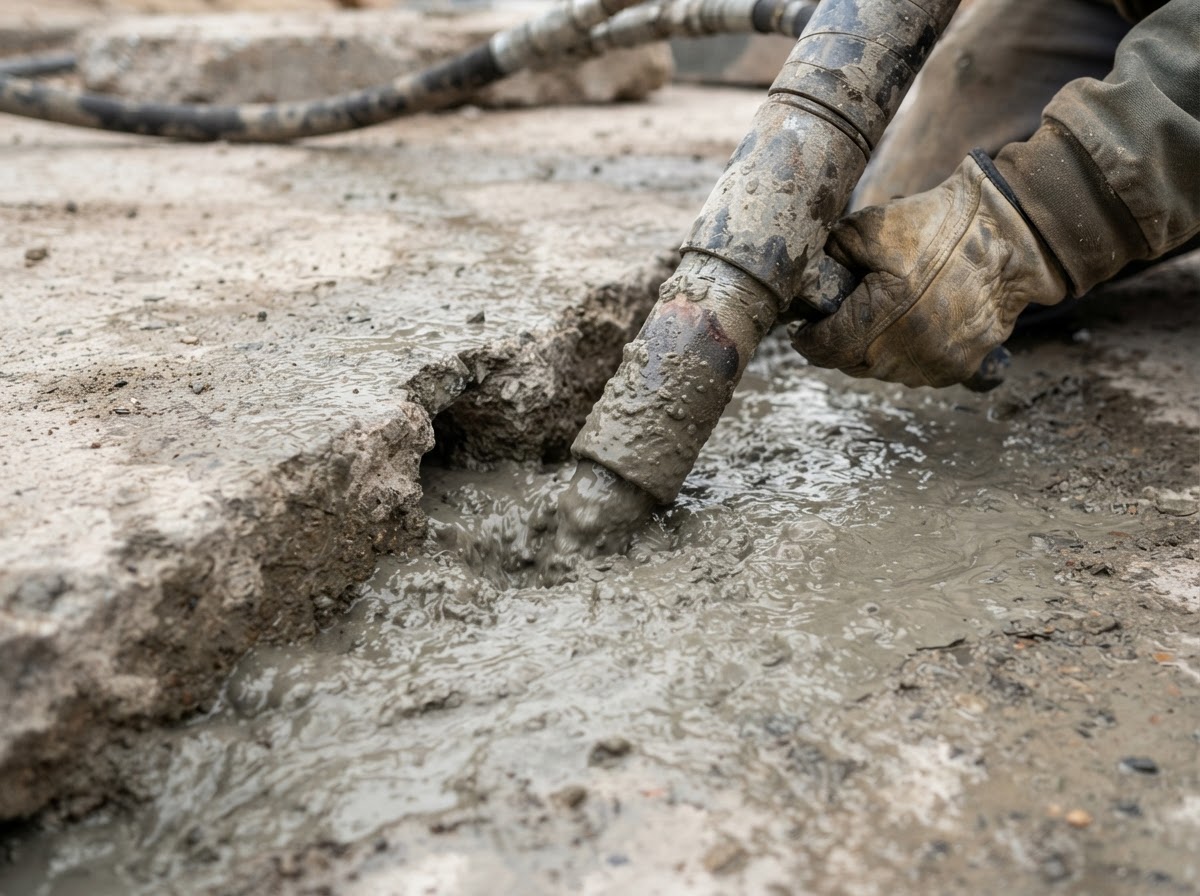
Mudjacking cementitious slurry being pumped through an access hole in a concrete slab

Slab Raising With Cementitious Slurry

Slab raising with cementitious slurry is the broader application of mudjacking to any settled residential or commercial slab that is intact but has dropped, tilted, or lost support. It applies wherever a suitable slab needs elevation recovery or void filling.

The slurry is pumped under pressure through access holes at lift points to fill the void and raise the concrete in a controlled way, with the grout volume and placement chosen for the slab thickness, access, void size, and the amount of lift required.

The result is a restored slab elevation with reduced trip hazards and improved transitions, preserving the existing concrete instead of replacing it.
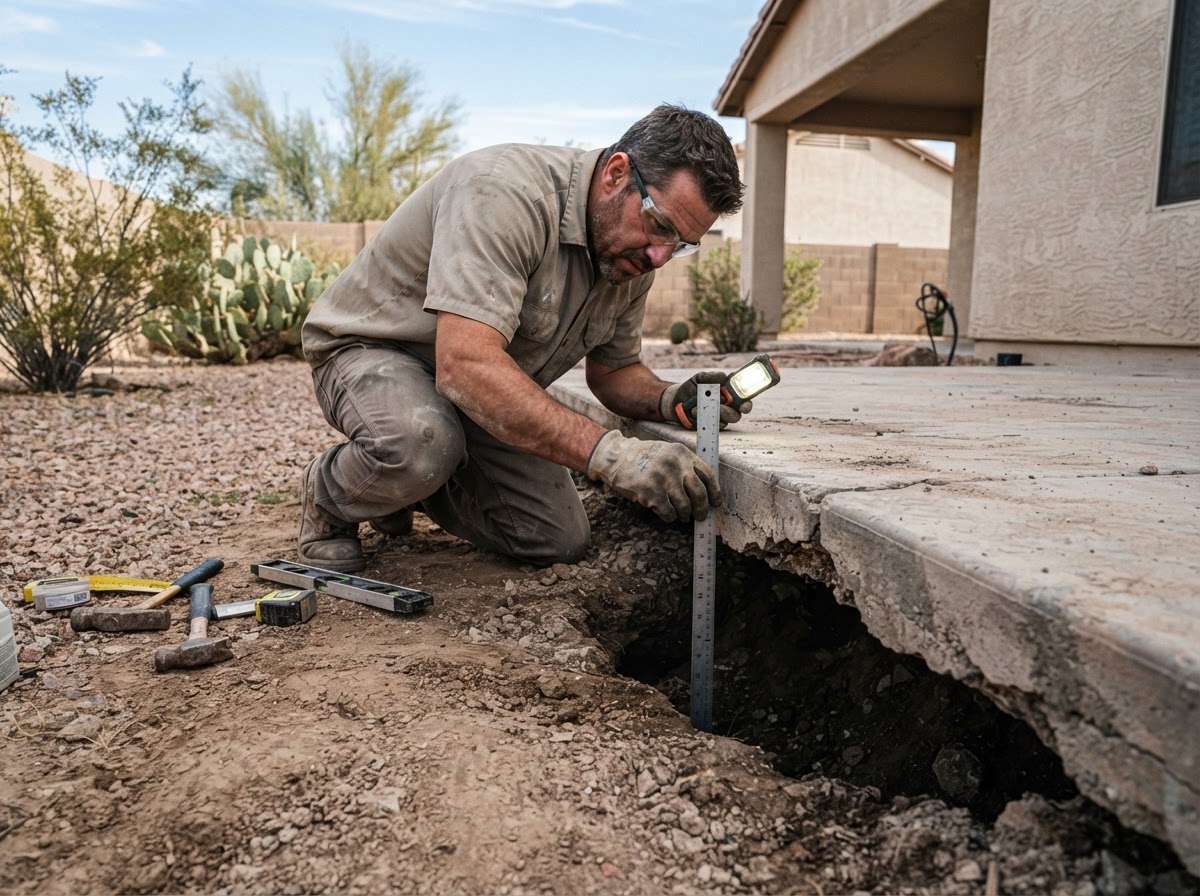
Technician inspecting slab support and elevation beneath a settled concrete slab

Void Filling and Support

Void filling and support with mudjacking slurry addresses the open space that forms beneath a slab when soil erodes or settles away from the underside of the concrete. It applies where the support beneath a slab has been lost, whether or not the surface has dropped significantly.

Cementitious slurry is pumped beneath the slab to fill the void and re-establish bearing under the concrete. The material and support objectives are not always identical to an actual elevation change — sometimes the goal is to fill and stabilize rather than to raise the slab.

The result is a slab with restored support beneath it, reducing the conditions that can lead to further settlement and cracking where the underlying void has been addressed.

Why Do Concrete Slabs Settle Before Mudjacking Is Needed?

Settlement that leads to mudjacking usually has more than one contributing cause. These are the factors most commonly found beneath settled Gilbert flatwork.

Poor or Variable Subgrade Compaction

If the subgrade beneath a slab was not uniformly compacted before the concrete was poured, the soil can settle unevenly over time. The slab above follows, creating the elevation differences that mudjacking is used to correct.

Water Movement and Erosion

Water moving along joints, edges, or downspout discharge can carry soil away from beneath a slab. Erosion removes the support under the concrete and lets the panel drop, which is why drainage is part of any mudjacking evaluation.

Changing Moisture Below Exterior Concrete

Gilbert soil goes through wet and dry cycles driven by monsoon moisture and irrigation. As soil moisture changes, the ground beneath a slab can expand, shrink, or shift, allowing the concrete above it to settle unevenly.

Voids Beneath the Slab

A void is the open space that forms when soil erodes or settles away from the bottom of the slab. Once a void exists, the concrete above it loses support and can crack or settle. Mudjacking slurry fills that void and restores bearing.

Settlement Between Adjacent Panels

Settlement often shows up first at transitions — where one driveway panel meets the next, or where a sidewalk panel meets its neighbor. These joint locations are where elevation loss becomes most visible and where mudjacking is frequently requested.

Signs Mudjacking May Be Worth Considering

These are common signs that a slab may be a candidate for slurry-based lifting. An on-site evaluation determines whether mudjacking is actually the right fit — these symptoms are not a remote diagnosis.

Intact but Sunken Slab

When a slab has dropped or tilted but the concrete itself is not badly cracked or fragmented, it is a strong candidate for mudjacking. The intact slab can be lifted and supported with slurry rather than replaced.

Uneven Transition Between Panels

A visible height difference at a joint between two panels is a clear sign that the lower panel has settled. Where the lower panel is intact, mudjacking can lift it back into alignment with its neighbor.

Low Driveway or Patio Section

A driveway or patio section that has dropped and created a low spot, a lip, or a puddle is a common sign of settlement. Mudjacking raises the dropped section back toward the surrounding elevation.

Loss of Support Beneath Concrete

A slab that sounds hollow when tapped, or that shows cracking consistent with lost support beneath it, may have a void underneath. Mudjacking slurry fills that void and restores bearing under the concrete.

Leveling Potentially More Economical Than Replacement

When the slab is sound and the problem is settlement, mudjacking is usually more economical than demolition and repouring. An inspection confirms whether the concrete is a good candidate for lifting or whether replacement is the better investment.

Our Mudjacking Process

A clear, condition-first process keeps the project straightforward from evaluation to final walkthrough.

  1. 1

    Inspect the Slab

    The slab is inspected for settlement, voids, cracking, and overall condition to confirm it is intact enough to be lifted as a unit with cementitious slurry.

  2. 2

    Evaluate Support and Elevation

    The surrounding grade, drainage, and adjacent panel elevations are reviewed alongside the likely void areas so the repair targets the actual cause of the settlement.

  3. 3

    Select Appropriate Slurry-Based Lifting Scope

    Based on slab condition, void size, access, and the lift required, the slurry volume, access-hole layout, and lift points are planned for the specific project.

  4. 4

    Review the Leveled Area and Next Steps

    The recovered elevation, panel transitions, drainage, and cleanup are reviewed, and return-to-use guidance is explained. No hazardous DIY drilling or pumping is expected of the property owner.

How Much Does Mudjacking Cost in Gilbert?

Exact price depends on the specifics of your slab and is set after an on-site evaluation. Detailed local dollar ranges are not published here because responsible pricing requires inspecting the project. These categories show what drives the cost of mudjacking.

Job typeTypical rangeWhat affects price
Single-panel raisingProject-specific estimateDriven by the panel size, amount of lift, void size, slurry volume, access, slab condition and thickness, and the number of treatment points. A single isolated panel sits at the lower end of the range.
Driveway mudjackingProject-specific estimateDriven by square footage and number of panels, amount of lift, void volume, slurry volume, access, slab condition, setup and mobilization, and the relationship to the garage and adjoining surfaces.
Sidewalk or walkway mudjackingProject-specific estimateDriven by the number of panels, length of the walk, lift amount, void size, access, and the relationship to adjoining surfaces and transitions.
Patio slab raisingProject-specific estimateDriven by area, lift amount, void volume, slurry volume, access, adjoining surfaces and transitions, and whether stabilization only or elevation correction is needed.
Void filling or supportProject-specific estimateDriven primarily by slurry volume required to fill the void, access, number of injection points, and whether a lift is also needed. Slab condition and whether replacement becomes more economical also factor in.

Ready to Raise Your Concrete With Mudjacking?

Get a clear estimate and honest guidance on whether slurry-based lifting is the right method for your Gilbert slab.

Call 602-905-1220Or fill out the form →

Request an Estimate

Tell us about your project. We'll follow up with clear pricing and next steps.

The customer/project address for the work.


Consent is optional. You may request an estimate without opting in to text messages.

Mudjacking vs. Polyjacking: Which Fits the Project?

Both methods lift settled concrete, but they use different materials, access holes, and project characteristics. Neither is universally superior — the right choice depends on the slab. See our polyjacking page for the foam method in detail.

CharacteristicMudjackingPolyjacking
Lifting materialCementitious slurry (grout)Expanding polyurethane foam
Relative hole sizeLarger access holesSmall injection holes
Material weightDenser and heavier than foamLightweight, little added load on soil
Lift characteristicsPressure-based slurry liftControlled expansion and lift
Access and site fitSuitable slabs and larger liftsResidential slabs, pool decks, neat-finish areas
Return-to-use considerationsSlurry needs time to set before full trafficFoam cures fast, often quicker return to use
Project economicsOften more economical for larger liftsMaterial cost, injection locations, area
Slab conditionSlab must be intact enough to lift as a unitSlab must be intact enough to lift as a unit

What is mudjacking?

Mudjacking is an established concrete leveling method that pumps a cementitious slurry under pressure through access holes in a settled slab to fill voids and raise the concrete. The denser, heavier grout fills the space beneath the slab and provides lifting force to bring the surface back toward its original elevation. Mudjacking remains a useful and often more economical option for suitable slabs and larger lifts.

Can mudjacking lift a sunken driveway?

Yes, mudjacking can lift a sunken driveway when the driveway panels are still largely intact and the settlement is the main problem. Cementitious slurry is pumped beneath the settled panels to fill the void and raise the concrete back toward the adjacent surface. Driveway panels that are badly broken, fragmented, or deteriorated may require replacement instead of mudjacking.

Can mudjacking be used on sidewalks and patios?

Yes, mudjacking can be used on sidewalks and patios where the slab is intact but has settled or lost support. The slurry is pumped through access holes to fill the void and lift the lower panel back into alignment with its neighbors. Sidewalk or patio concrete that is shattered, severely spalled, or no longer sound may need replacement rather than mudjacking.

What is the difference between mudjacking and polyjacking?

Mudjacking uses a denser cementitious slurry through larger access holes, while polyjacking uses lightweight, expanding polyurethane foam through smaller injection holes. Mudjacking is often more economical for larger lifts, while foam typically allows a faster return to use. The right choice depends on slab condition, void size, access, and how much lift is needed — neither method is universally superior.

Does mudjacking fill voids beneath concrete?

Yes, mudjacking fills voids beneath concrete because the cementitious slurry is pumped under the slab to occupy the open space where soil has eroded or settled away. The grout re-establishes bearing under the concrete while also providing the lifting force. Filling the void and raising the slab are related but not always identical objectives — sometimes stabilization is the goal rather than significant lift.

When is concrete too damaged for mudjacking?

Concrete is too damaged for mudjacking when the slab itself is severely cracked, badly fragmented, extensively deteriorated, or no longer structurally sound. Mudjacking relies on the slab being intact enough to be lifted as a unit; unsound concrete cannot be reliably raised into a lasting, usable surface. In those cases replacement is the more appropriate and more economical path.

How do I get a mudjacking estimate in Gilbert?

You can get a mudjacking estimate in Gilbert by calling 602-905-1220 or by filling out the estimate form on this page. Provide your name, phone number, email, project address, and a brief description of the concrete issue. A team member will follow up to schedule an on-site evaluation and determine whether mudjacking is the right method for your slab.

Request a Concrete Leveling Estimate

Talk to a Gilbert concrete leveling specialist with 10+ years of experience. Insured work, clear pricing, and a straightforward process — no pressure.

602-905-1220

Request an Estimate

Tell us about your project. We'll follow up with clear pricing and next steps.

The customer/project address for the work.


Consent is optional. You may request an estimate without opting in to text messages.