10+ Years ExperienceInsured
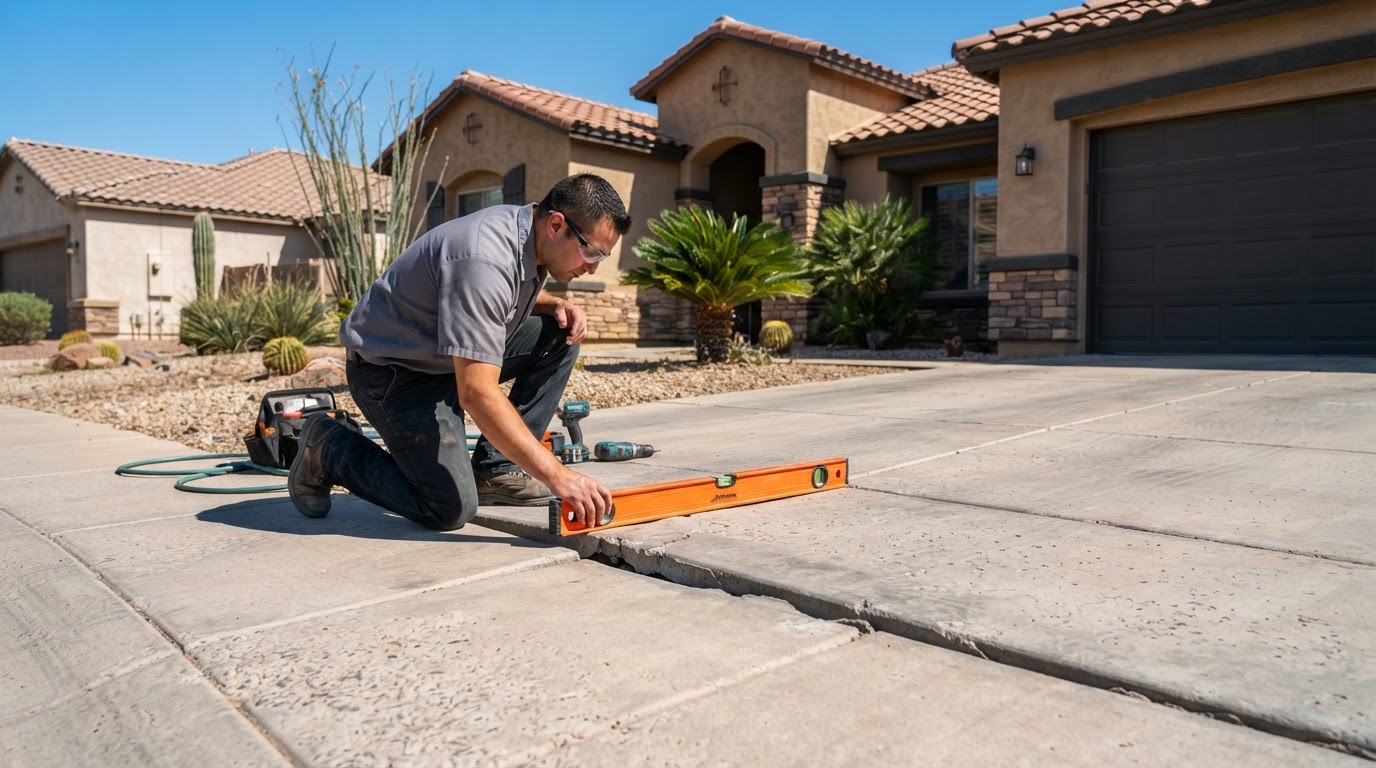
Concrete leveling technician evaluating an uneven settled driveway slab at a Gilbert, Arizona home

10+ Years Experience · Insured

Residential Concrete Leveling in Gilbert, AZ

We lift and stabilize settled residential concrete — driveways, sidewalks, patios, pool decks, and garage floors — using the method that fits your slab, soil, and budget instead of automatically replacing good concrete.

Request an Estimate

Tell us about your project. We'll follow up with clear pricing and next steps.

The customer/project address for the work.


Consent is optional. You may request an estimate without opting in to text messages.

Residential concrete around a Gilbert home includes driveway panels, sidewalks, patios, pool decks, garage floors, walkways, and entry slabs — and nearly all of it is exposed to intense Arizona heat and seasonal moisture changes. When the subgrade beneath that flatwork settles, erodes, or shifts, the slab above it drops, tilts, or loses support. Residential concrete leveling corrects that settled or uneven concrete by lifting it back toward its original elevation with the method that fits the slab, the void, and the access — whether that is polyurethane foam leveling, mudjacking with a cementitious slurry, or void filling and slab stabilization. The goal is to preserve existing concrete wherever it is still sound rather than tear out and replace a usable slab.

Settlement can relate to subgrade compaction, soil moisture changes, erosion, drainage, void formation, or local soil movement, and visible settlement can have more than one contributing cause. That is why an inspection comes first — to diagnose what is actually happening beneath the concrete before a method is selected. With 10+ years of experience and insured service, Gilbert Concrete Leveling helps Gilbert homeowners compare leveling against replacement honestly. Leveling is most appropriate when the slab remains sufficiently intact but has settled or lost support; replacement may be more appropriate when the concrete itself is severely broken, deteriorated, or unsuitable for lifting. Learn more on our concrete leveling overview or the about page.

Why Gilbert Homeowners Choose Gilbert Concrete Leveling

Residential flatwork has more than one possible cause of settlement and more than one possible fix. Our role is to diagnose the slab, explain the realistic options, and recommend the repair that fits your property.

  • 10+ Years of Experience

    Over a decade of hands-on residential concrete leveling and lifting across Gilbert driveways, sidewalks, patios, pool decks, and garage floors.

  • Insured

    Gilbert Concrete Leveling is insured for the residential concrete leveling work we perform on your property.

  • Residential Flatwork Specialization

    Our focus is concrete leveling and lifting for residential slabs — not general contracting — so the evaluation is built around how residential flatwork actually settles.

  • Multiple Leveling Methods

    We select between polyurethane foam, mudjacking, and void filling based on what your slab and soil require, rather than recommending one method for every job.

  • Repair-vs-Replacement Guidance

    You get an honest comparison of whether your slab is a good candidate for leveling or whether replacement is the better investment.

  • Clear Estimates and Process

    Pricing guidance and the project process are explained plainly, with a straightforward next-step review after the work.

  • Gilbert-Area Outdoor Concrete Familiarity

    Experience with local heat exposure, soil moisture, drainage, and monsoon conditions that affect how residential slabs settle here.

  • Easy Call and Form Access

    Request an estimate by phone at 602-905-1220 or through the form on this page — no pressure, just a clear evaluation of your concrete.

What Residential Concrete Leveling Covers in Gilbert

Residential concrete leveling covers settled exterior flatwork and selected slabs where the existing concrete remains suitable for lifting or stabilization. That includes driveway panels that have dropped near the garage or street, sidewalk panels with uneven transitions, patio slabs with settled corners, pool deck sections near the coping, garage floor slabs, walkways, and entry slabs. In each case the work targets the elevation, support, and transition problems beneath and between the slabs.

It is important to distinguish what this category does and does not cover. Settled flatwork that is largely intact is a candidate for lifting. Severely deteriorated concrete that is badly broken, extensively cracked, or no longer structurally sound may need replacement rather than leveling. And foundation or structural problems that affect the home itself require a different type of evaluation — residential concrete leveling is not foundation repair and does not repair a building's structural foundation. An inspection determines which category your slab falls into.

Our Residential Concrete Leveling Services in Gilbert

Each service below corrects a specific type of settled residential concrete. The common thread is lifting and stabilizing the existing slab wherever it is still sound, rather than replacing concrete that still has useful life.

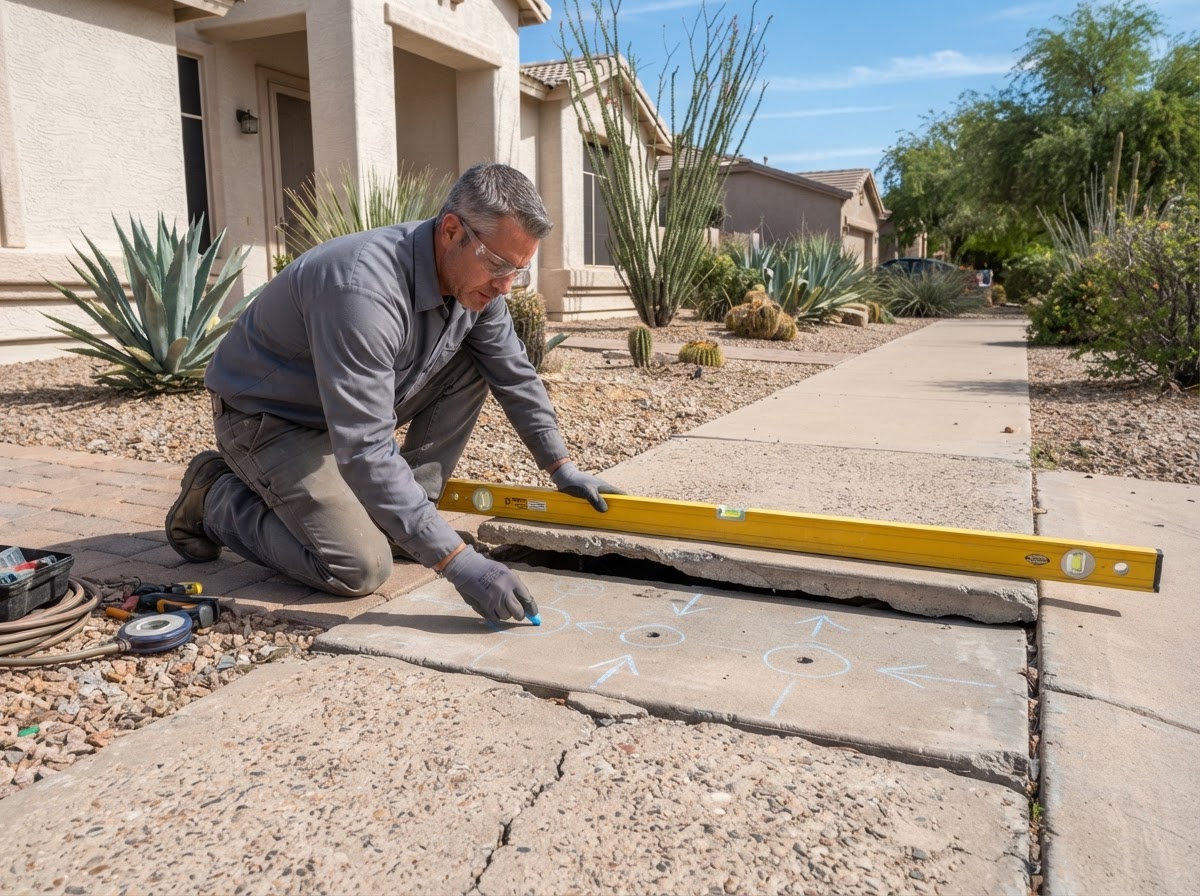
Technician checking residential slab elevation with a level tool

Concrete Lifting and Slab Lifting

Concrete lifting, or slab lifting, raises settled residential flatwork back toward its original elevation instead of removing the concrete. It is used on driveways, sidewalks, patios, pool decks, and slabs where the concrete is still intact but has dropped, tilted, or lost support beneath it.

A lifting material — polyurethane foam through small injection holes or a cementitious mudjacking slurry through larger holes — is introduced at lifting points beneath the slab to fill voids and raise the concrete in a controlled way. The choice depends on slab condition, void size, and the transitions between adjacent panels.

The result is a more even, safer surface with reduced trip hazards and improved transitions between slabs, while preserving the existing concrete and avoiding the cost and disruption of a full tear-out.
Learn about slab lifting
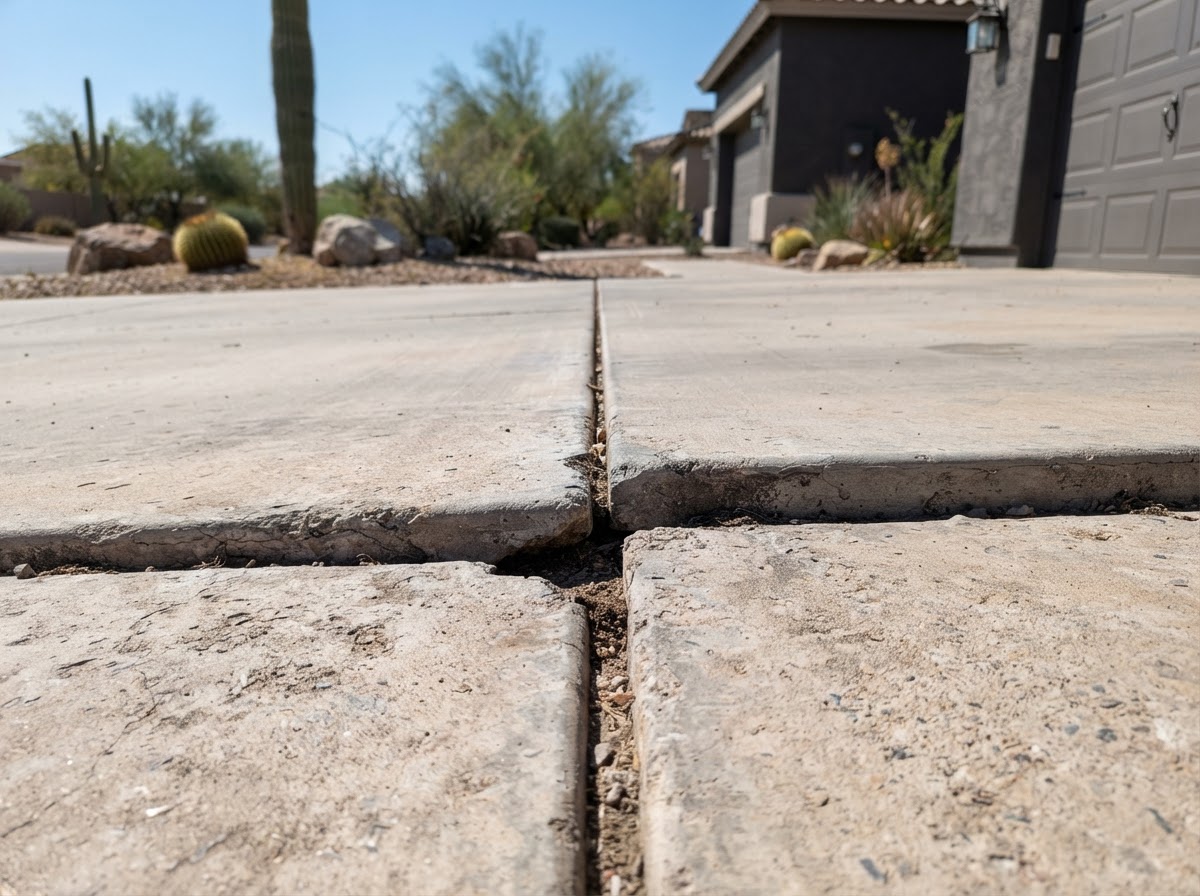
Settled residential driveway panels with a height offset at the control joint

Driveway Leveling

Driveway leveling corrects sunken or tilted driveway panels that have created a lip, a puddle, or an uneven transition at the garage approach or between driveway sections. Driveway panels in Gilbert often settle where the subgrade has compacted or eroded over time beneath the slab.

Lifting material is injected beneath the settled driveway panels to fill the void and raise the concrete back toward the adjacent panels. Control joints and expansion joints are taken into account so the lift improves the surface slope and the panel-to-panel transitions.

Homeowners get a smoother, safer driveway with fewer trip hazards and better drainage away from the garage, without the demolition and cure time required to replace the driveway.

Learn about driveway leveling
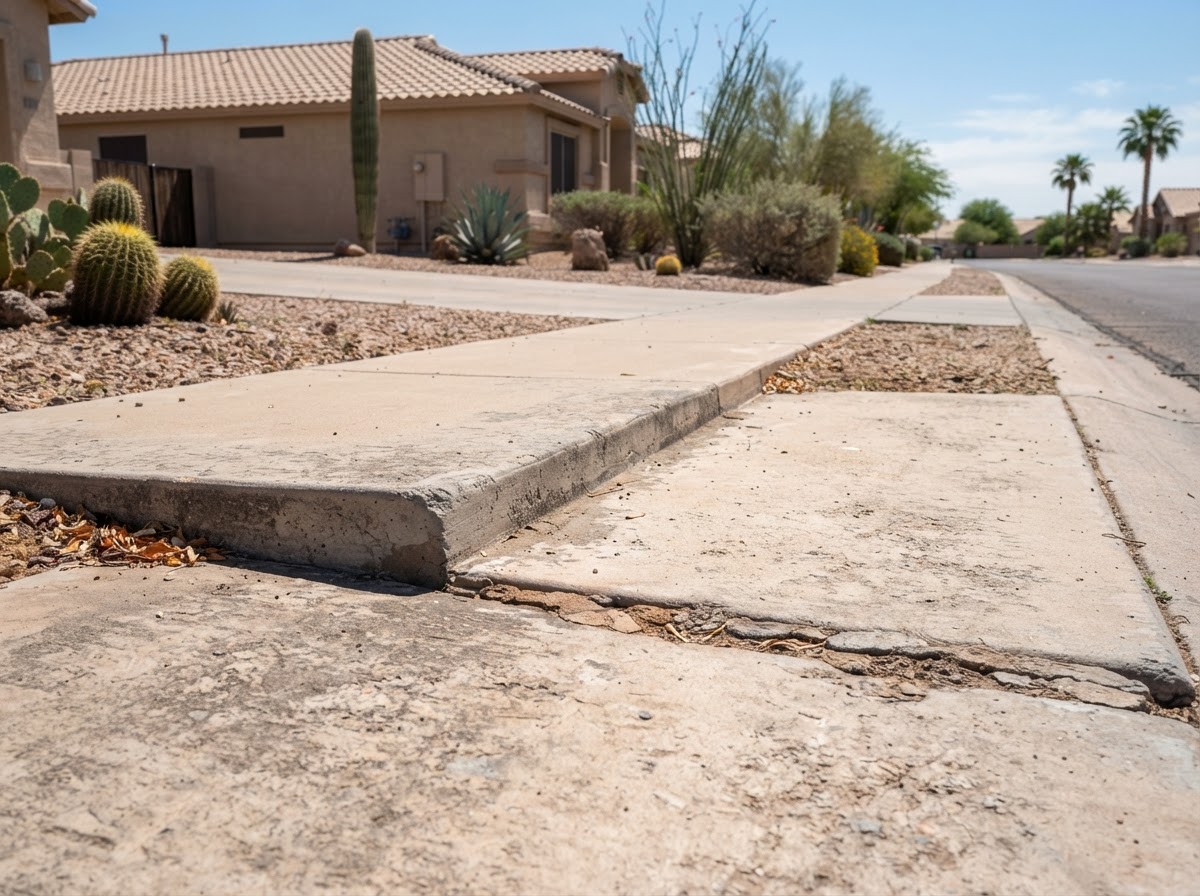
Concrete sidewalk panels with a raised trip-hazard lip at the joint

Sidewalk Leveling

Sidewalk leveling raises a sidewalk panel that has settled below its neighbor, eliminating the trip hazard that forms at the joint between the two panels. Sunken sidewalk panels are common along Gilbert frontages where the subgrade has shifted or where water and tree roots have affected the support beneath the walk.

The lower panel is lifted back into alignment with surrounding sidewalk panels using foam or slurry injected through access holes, restoring an even joint line and a continuous walking surface.

The outcome is a safer pedestrian path with a reduced trip hazard and a more uniform surface — preserving the existing sidewalk concrete instead of cutting and repouring the section.

Learn about sidewalk leveling
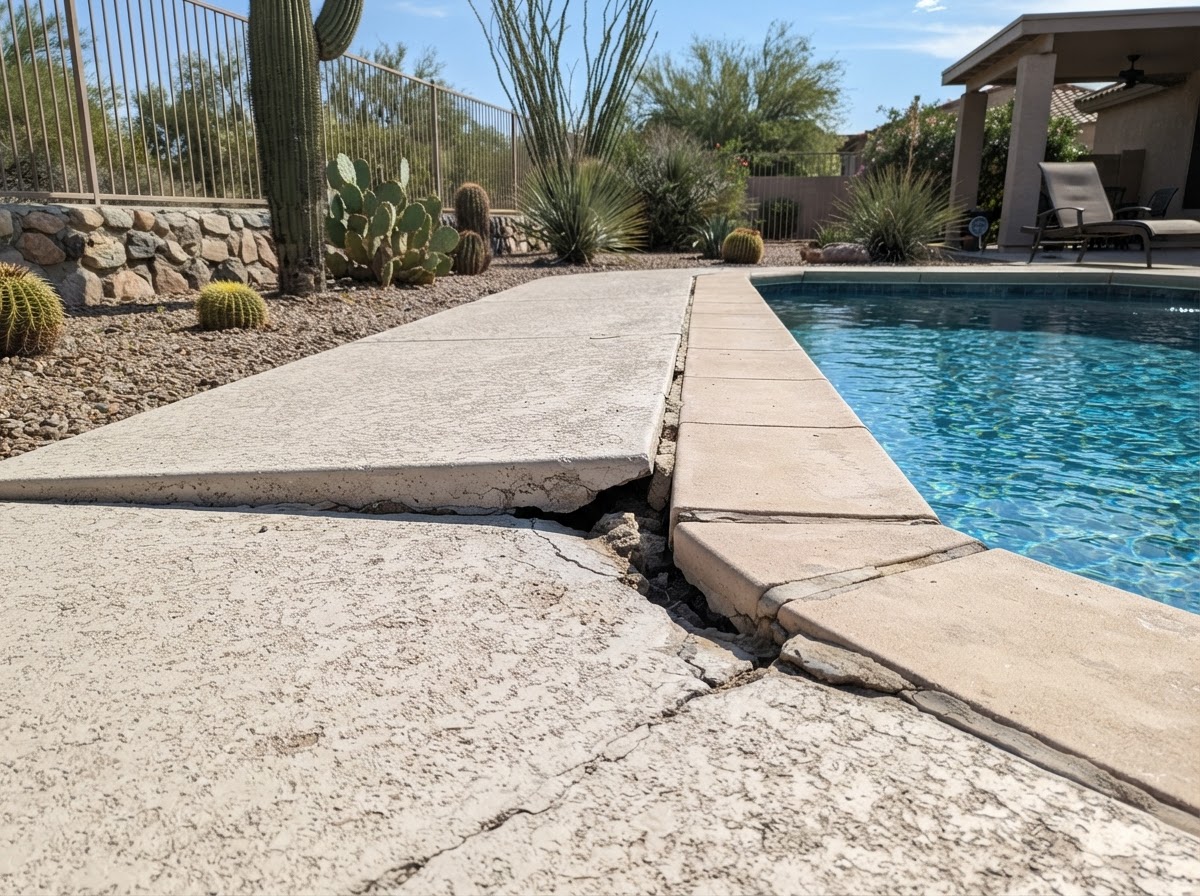
Settled concrete pool deck slab near the coping of an Arizona backyard pool

Pool Deck Leveling

Pool deck leveling addresses settled sections of the concrete deck surrounding a swimming pool, where slabs often drop near the coping and create uneven transitions around the water. Arizona pool decks are exposed to intense sun and moisture swings that can affect the support beneath them.

Small-diameter injection holes keep disruption to the deck minimal, and lightweight polyurethane foam is commonly used to fill voids and lift the settled deck back toward the coping and adjacent slabs. Cracks and joints in the deck are evaluated to confirm the sections are sound enough to lift.

The result is a more even, safer surface around the pool with improved transitions — restoring the usable deck without the mess and downtime of tearing out and repouring pool deck concrete.

Learn about pool deck leveling
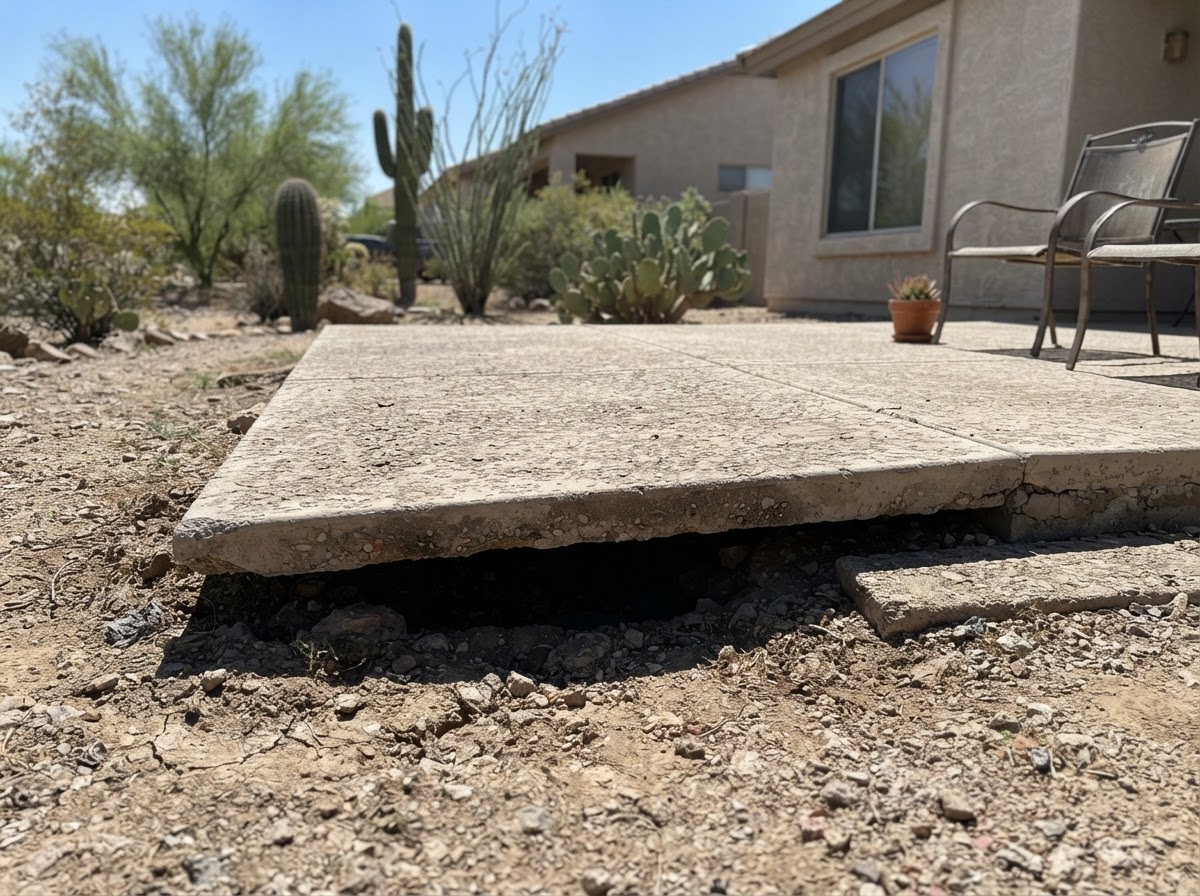
Settled backyard patio slab with a sunken corner in an Arizona yard

Patio Leveling

Patio leveling corrects a patio slab that has settled at a corner or edge, creating a tilted surface, a gap beneath the slab, or a low spot that holds water. Patio slabs in Gilbert yards are exposed to the same heat and moisture cycles as other outdoor flatwork.

Lifting material is introduced beneath the settled area to fill the void and bring the patio back toward level, with attention to how the surface drains away from the home and the transitions to doors and walkways.

Homeowners regain a flat, usable patio with improved drainage and a reduced trip edge, keeping the existing patio slab in place rather than replacing it.

Learn about patio leveling
Technician inspecting a settled garage floor slab transition

Garage Floor Leveling

Garage floor leveling addresses a settled or cracked garage floor slab, particularly near the entrance where the floor meets the driveway approach. A dropped garage floor can create a transition lip and an uneven surface for parking.

Depending on the slab condition and the size of any void beneath the floor, foam or slurry is used to lift and support the settled area and restore a more even surface across the garage. This is slab leveling for the garage floor, not repair of the home's structural foundation.

The outcome is a smoother garage floor with a better transition at the entrance and improved support beneath the slab, where leveling is technically appropriate for the condition present.

Learn about garage floor leveling
Residential concrete slab being assessed for settlement and voids

Concrete Slab Leveling

Concrete slab leveling is the broader application of lifting and stabilizing any settled residential slab — walks, steps, landings, and similar flatwork — that has dropped but is still serviceable. It applies wherever a slab has lost elevation relative to its surroundings.

The slab is inspected for voids and settlement, then a lifting material is placed beneath it to fill the void and recover elevation, with the method chosen for the slab thickness, access, and the amount of lift required.

The result is a restored, more usable slab surface with improved support and a reduced height difference at transitions, avoiding replacement where the concrete still has useful life.

Learn about concrete slab leveling
Void filling and slab stabilization beneath a settled residential concrete slab

Concrete Void Filling and Slab Stabilization

Void filling and slab stabilization address the gap that forms beneath a residential slab when soil erodes or settles away from the concrete, even before the slab has dropped significantly. Stabilizing the support helps reduce the risk of further movement of the surface above.

Material is introduced beneath the slab to fill the void and re-establish bearing under the concrete. This is distinct from forcing an unnecessary lift — the goal may be to fill and stabilize rather than to raise the slab at all.

The outcome is a slab with restored support beneath it, reducing the risk of future settlement and cracking where the underlying void has been addressed.

Learn about concrete void filling
Uneven sidewalk joint transition creating a trip hazard between panels

Concrete Trip-Hazard Repair

Trip-hazard repair targets the raised lip at a joint where one residential concrete panel has settled or heaved relative to the next, creating a stumble point for foot traffic. These offsets commonly occur on sidewalks, driveways, and pool decks.

Where the concrete is intact, the lower panel is lifted back into alignment to remove the height difference at the joint. Where a panel is shattered or unsound, that section may need replacement rather than lifting. Whether the result meets a specific code or standard requires a project-specific evaluation.

The result is a safer walking and driving surface with the trip hazard reduced at the joint, improving safety for residents and visitors without a full slab replacement.

Learn about trip hazard repair

When Does Residential Concrete Need Leveling?

These are common signs that a residential slab may be a candidate for leveling. An on-site inspection confirms the cause — these symptoms are not a remote diagnosis.

One Slab Panel Sits Lower Than the Next

When one driveway, sidewalk, or patio panel has visibly dropped below its neighbor, the height difference at the joint is a clear sign of settlement beneath the lower panel. That offset is exactly what leveling is designed to correct by raising the dropped panel back into alignment.

A Driveway Has Settled Near the Garage or Walkway

A driveway that has dropped near the garage approach creates a lip, an uneven drive-in transition, or a low spot that holds water. Settlement near the garage or street transition is one of the most common residential leveling requests in Gilbert.

Water Collects Where the Slab Has Dropped

When a slab settles and creates a low spot, water collects in the depression instead of draining away. Standing water on a driveway, patio, or pool deck is often a sign that the surface slope has changed and the slab may need lifting.

A Sidewalk or Patio Has Developed an Uneven Transition

An uneven transition at a joint — where foot traffic catches on a raised lip — is a sign that one panel has moved relative to the next. These transitions are trip hazards and a common reason property owners call for sidewalk or patio leveling.

A Slab Sounds Hollow or Shows Signs of Lost Support

A slab that sounds hollow when tapped, or that shows cracking and movement consistent with lost support beneath it, may have a void underneath. Void filling and slab stabilization address that lost support before the surface drops further.

How We Approach Residential Concrete Leveling

A clear process keeps the project straightforward from the first call to the final walkthrough.

  1. 1

    Inspect concrete condition and surrounding elevations

    The slab is inspected for settlement, voids, cracking, and how the surrounding grade, drainage, and adjacent panels relate to the concrete.

  2. 2

    Identify likely loss of support or settlement pattern

    Lifting points and void areas are located so the repair targets the actual cause — subgrade compaction, erosion, moisture, or void formation — rather than only the visible symptom.

  3. 3

    Compare lifting methods and replacement where necessary

    Based on slab condition, access, void size, and lift needed, a method — polyurethane foam, mudjacking, or void filling — is selected, or replacement is recommended if the concrete is unsuitable for lifting.

  4. 4

    Perform controlled leveling or stabilization

    Material is introduced beneath the slab at the identified points to fill voids and raise the concrete in a controlled way, without hazardous DIY drilling or injection by the homeowner.

  5. 5

    Review transitions, drainage implications, cleanup, and next steps

    The recovered elevation, panel transitions, drainage, and site cleanup are reviewed, and any return-to-use guidance or follow-up is explained.

What Does Residential Concrete Leveling Cost in Gilbert?

Exact price depends on the specifics of your slab and is set after an on-site evaluation. Detailed local dollar ranges are not published here because responsible pricing requires inspecting the project. These categories show what drives the cost.

Job typeTypical rangeWhat affects price
Small isolated slab or panel correctionProject-specific estimateDriven by the number and size of slabs, square footage, amount of settlement, and whether a single panel or a small area is involved. Smaller isolated jobs sit at the lower end of the range.
Multi-panel driveway or walkway levelingProject-specific estimateDriven by square footage and number of panels, amount of lift, void size and depth, material volume, access, slab thickness and condition, and the method selected (polyjacking vs mudjacking).
Patio or pool deck levelingProject-specific estimateDriven by area, lift amount, void volume, injection locations, adjoining surfaces and transitions, and whether stabilization only or elevation correction is needed.
Void filling or slab stabilizationProject-specific estimateDriven primarily by material volume required to fill the void, access, number of injection points, and whether a lift is also needed. Extent of cracking or deterioration and whether replacement becomes more economical also factor in.

Ready to Level Your Residential Concrete?

Get a clear estimate and honest repair-vs-replacement guidance for your Gilbert home from a concrete leveling specialist.

Call 602-905-1220Or fill out the form →

Request an Estimate

Tell us about your project. We'll follow up with clear pricing and next steps.

The customer/project address for the work.


Consent is optional. You may request an estimate without opting in to text messages.

Can sunken residential concrete usually be leveled instead of replaced?

Yes, sunken residential concrete can usually be leveled instead of replaced when the slab itself is still largely intact and the problem is settlement or lost support beneath it. Driveway panels, sidewalks, patios, pool decks, and garage floors that have dropped but are not badly broken are good candidates for lifting. Concrete that is severely cracked, deteriorated, or fragmented may need replacement instead.

Can you level a driveway that has settled near the garage?

Yes, a driveway that has settled near the garage approach can usually be leveled by lifting the dropped panels back toward the adjacent surface. Lifting material is introduced beneath the settled driveway panels to fill the void and recover elevation, improving the transition at the garage and the surface slope. Badly broken driveway panels may require replacement rather than lifting.

Can sidewalk panels be lifted to reduce uneven transitions?

Yes, sidewalk panels can be lifted to reduce the uneven transition at a joint where one panel has settled below the next. Raising the lower panel back into alignment removes the height difference that creates the trip hazard. Sidewalk panels that are shattered or structurally damaged may instead need to be replaced.

Can a settled pool deck be leveled?

Yes, a settled pool deck can often be leveled, especially sections that have dropped near the coping and created an uneven transition. Small-diameter injection holes and lightweight polyurethane foam are commonly used to fill voids and lift the deck back toward the surrounding elevation. Pool deck concrete that is cracked through or crumbling may require replacement instead.

What causes residential concrete to settle in Gilbert?

Residential concrete in Gilbert settles due to a combination of factors — changing soil moisture from monsoon storms and irrigation, variable subgrade compaction, drainage and water movement that erodes soil from beneath slabs, heat and joint movement from long outdoor exposure, and voids that form as support is lost. No single factor explains every case, which is why an inspection matters before a method is chosen.

How do you choose between polyjacking and mudjacking for a home?

The choice between polyjacking and mudjacking for a home depends on slab condition, the size and depth of any void, how much elevation needs to be recovered, access to the area, and project economics. Polyurethane foam uses small holes and a lightweight material, while mudjacking uses a denser cementitious slurry through larger holes. An on-site inspection determines which method fits the specific slab.

Will leveling repair cracks in the concrete itself?

Concrete leveling addresses the elevation and support beneath a slab, not the cracks in the concrete surface itself. Lifting can reduce the stress and movement that contributed to cracking, and it can close or narrow some cracks as the slab is realigned, but it does not restore the concrete material to an uncracked condition. Badly cracked or deteriorated concrete may need replacement.

How do I get an estimate for residential concrete leveling?

You can get an estimate for residential concrete leveling by calling 602-905-1220 or by filling out the estimate form on this page. Provide your name, phone number, email, project address, and a brief description of the concrete issue. A team member will follow up to schedule an on-site evaluation of your settled or uneven concrete.

Request a Concrete Leveling Estimate

Talk to a Gilbert concrete leveling specialist with 10+ years of experience. Insured work, clear pricing, and a straightforward process — no pressure.

602-905-1220

Request an Estimate

Tell us about your project. We'll follow up with clear pricing and next steps.

The customer/project address for the work.


Consent is optional. You may request an estimate without opting in to text messages.