10+ Years ExperienceInsured
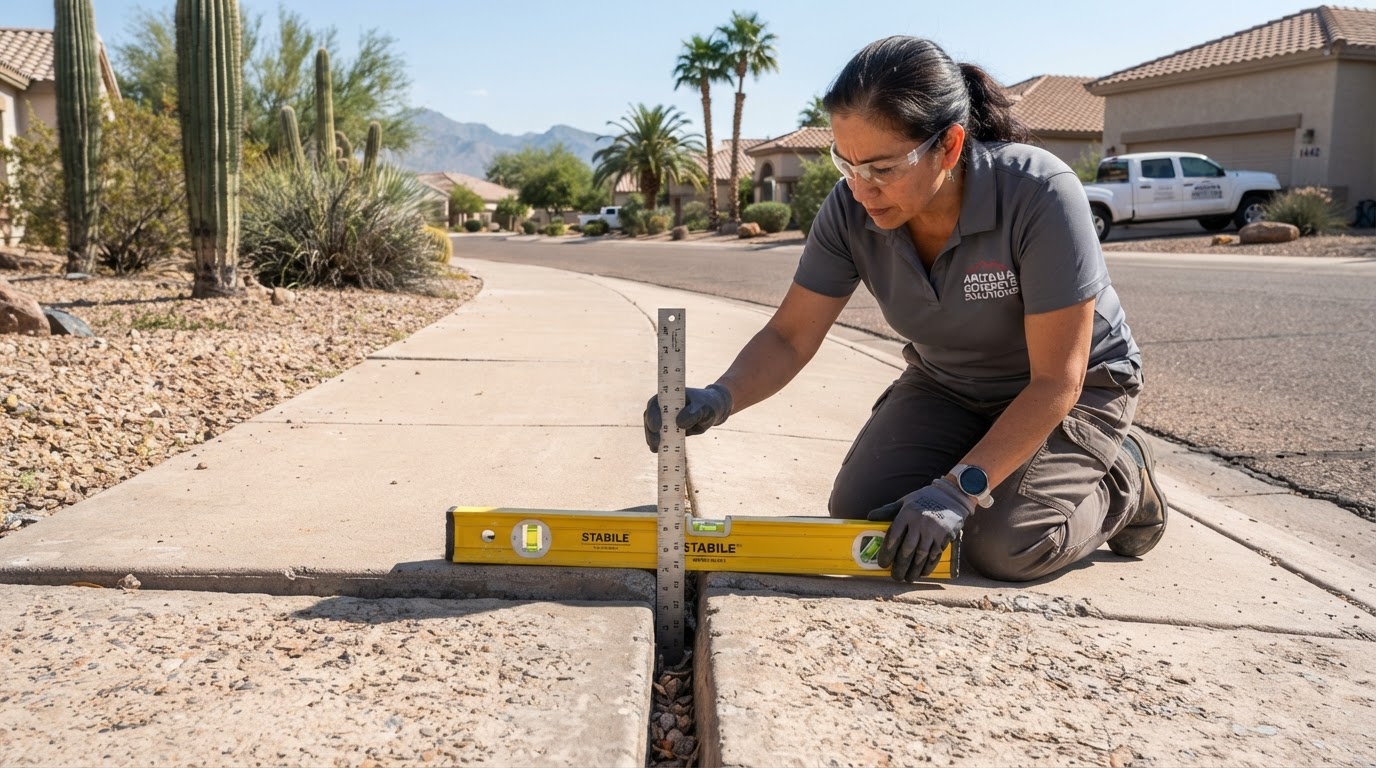
Concrete technician measuring an uneven sidewalk transition with a ruler and level at the joint between two panels

10+ Years Experience · Insured

Concrete Trip Hazard Repair in Gilbert, AZ | 10+ Years Experience

Uneven concrete transitions evaluated and corrected where leveling fits — with honest guidance on when a heaved or deteriorated panel needs a different repair.

Request an Estimate

Tell us about your project. We'll follow up with clear pricing and next steps.

The customer/project address for the work.


Consent is optional. You may request an estimate without opting in to text messages.

Concrete trip hazards often occur where adjacent slab surfaces no longer meet evenly, producing a vertical transition at a joint or edge. Causes may include settlement, heaving, roots, erosion, compaction changes, moisture, drainage, or movement at joints — and the type of movement matters. Leveling may correct some settled-low panels by raising the dropped surface back into alignment with its neighbor, but a raised or heaved panel cannot be fixed by lifting from beneath because the concrete has been pushed upward, not down. This page focuses on concrete-leveling-related correction and evaluation, not legal liability advice. See our sidewalk leveling page and the commercial concrete leveling overview for related services.

Measurements, property type, ownership and responsibility, and applicable standards all matter when evaluating a trip hazard. Concrete leveling alone does not automatically make a walkway ADA or code compliant — compliance depends on the overall walkway conditions and the relevant standards for the specific site. Public right-of-way work may require jurisdictional authorization, and responsibility for a public sidewalk depends on the specific location and jurisdiction. A badly deteriorated, heaved, or root-displaced panel may require a different repair path than leveling. With 10+ years of experience and insured service, Gilbert Concrete Leveling evaluates which surface moved, why it matters, and whether leveling is the appropriate correction — or whether the panel needs replacement or another approach.

Why Gilbert Property Owners Choose Us for Concrete Trip Hazard Repair

Not every trip hazard should be lifted. Our role is to identify which surface moved, why, and whether leveling is the right correction — or whether the panel needs a different repair.

  • 10+ Years of Experience

    A decade of evaluating uneven concrete transitions across Gilbert, from residential sidewalks to HOA common areas and commercial walkways.

  • Insured

    Gilbert Concrete Leveling is insured for the concrete trip hazard evaluation and leveling work we perform on your property.

  • Pedestrian-Transition Assessment

    The evaluation is built around the vertical transition at the joint — which surface moved, how much, and whether the panel is intact enough to be leveled.

  • Leveling vs Replacement Distinction

    We distinguish a settled panel that can be lifted from a heaved, badly broken, or root-displaced panel that needs a different repair, and recommend accordingly.

  • Multiple Lifting Methods

    We select between polyjacking and mudjacking based on what the panel, voids, and access require — not one method for every transition.

  • Residential, HOA, and Commercial Flatwork Experience

    Experience across the pedestrian surfaces where trip hazards commonly form — sidewalks, walkways, driveways, entries, and common areas.

  • Right-of-Way Awareness

    We recognize that public right-of-way sidewalks may involve municipal responsibility, permits, or authorization that must be confirmed before private work proceeds.

  • Clear Repair Scope and Estimates

    Pricing is explained by the factors that drive it — number of transitions, panel dimensions, movement type, method, and access — and the scope is laid out plainly.

Concrete Trip Hazard and Uneven-Slab Services

Each application below addresses a specific type of uneven concrete transition where leveling may be an appropriate correction. The method is chosen for the panel condition and the type of movement.

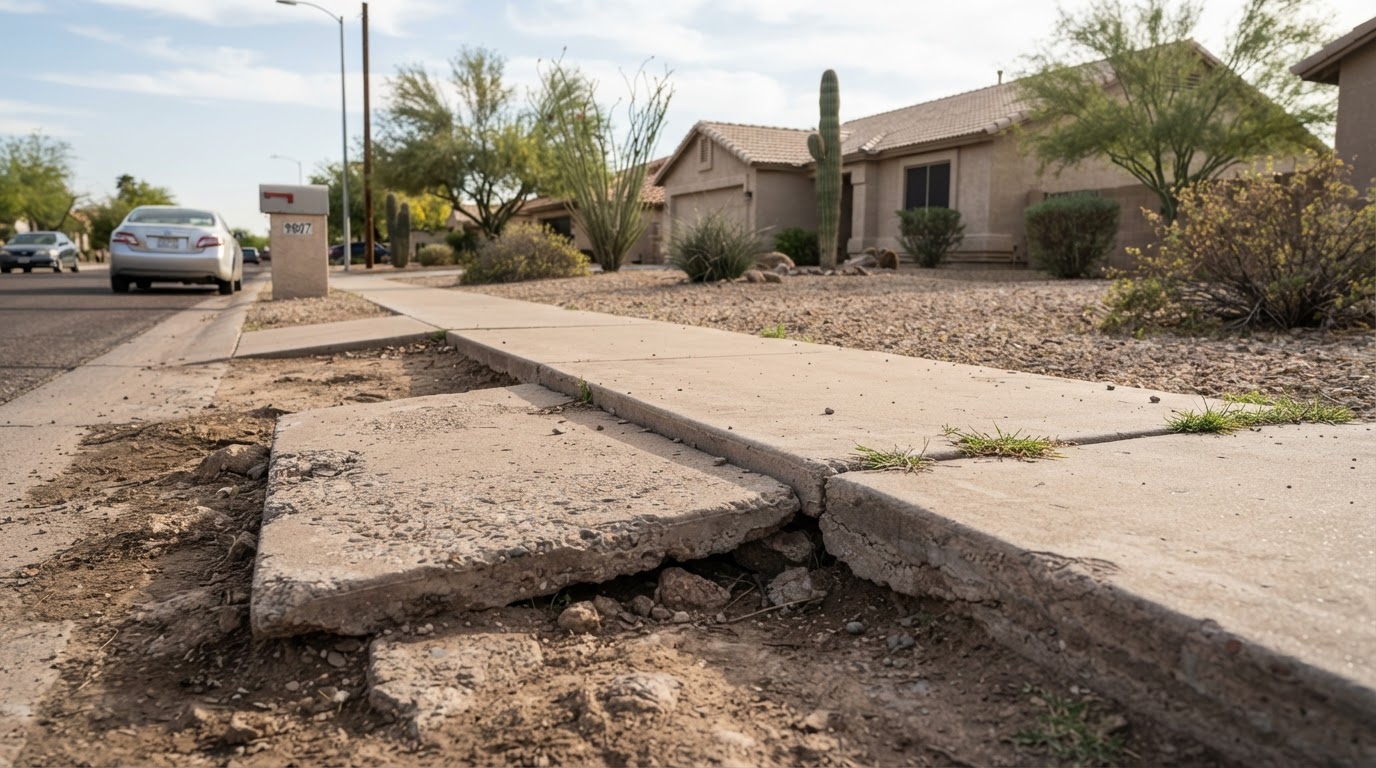
Settled pedestrian sidewalk panel that has dropped below the adjoining panel creating an uneven transition

Sidewalk Trip Transition Leveling

Sidewalk trip transition leveling reduces the vertical transition at a joint where one sidewalk panel has settled below its neighbor, creating a trip hazard for pedestrian traffic. It applies where the lower panel is intact but has dropped.

Leveling material — polyurethane foam or cementitious slurry — is introduced beneath the lower panel to fill the void and raise the concrete back into alignment, restoring an even joint line. The panel condition is evaluated to confirm it is sound enough to lift.

The outcome is a safer walking surface with the trip transition reduced at the joint, preserving the existing sidewalk panel instead of cutting and repouring the section.
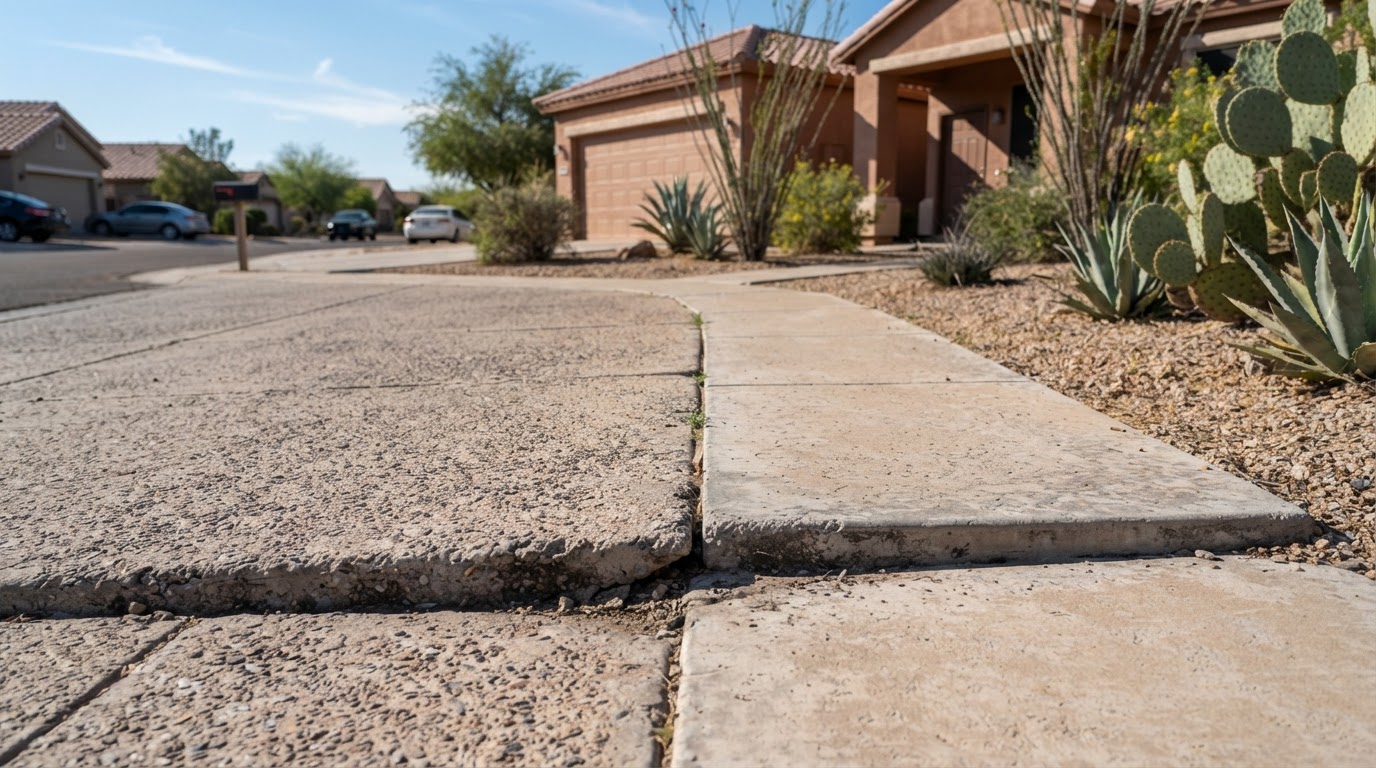
Driveway to walkway concrete transition showing a height difference where the two surfaces meet

Driveway-to-Walkway Transition Repair

Driveway-to-walkway transition repair addresses a height difference where the driveway meets an adjoining walkway, creating an uneven transition between the two surfaces. It applies where one surface has settled relative to the other and the lower panel is intact.

Leveling material is introduced beneath the lower surface to fill the void and raise it back toward the adjoining surface, restoring an even transition. The control and expansion joints at the transition and the drainage conditions are part of the evaluation.

The result is a smoother, safer transition between the driveway and walkway with the trip edge reduced, preserving the existing concrete instead of replacing the section.

Uneven concrete entry pathway with a settled slab section creating a transition at the threshold

Entry and Pathway Uneven Concrete Repair

Entry and pathway uneven concrete repair addresses settled slabs near entries, front walks, and paths where a panel has dropped and created a transition at a threshold or between adjoining surfaces. It applies where the concrete is intact but has lost elevation.

Leveling material is introduced beneath the settled section to fill the void and recover elevation, improving the transition at the entry and the surface slope. The panel condition and the relationship to the adjoining surfaces are evaluated before a method is selected.

The outcome is a smoother, safer entry and pathway with the trip transition reduced, preserving the existing concrete where leveling is appropriate.

HOA common-area concrete sidewalk in a planned residential community showing multiple walkway panels

HOA Common-Area Trip Hazard Evaluation

HOA common-area trip hazard evaluation assesses uneven sidewalk and walkway panels across shared pedestrian surfaces in a residential community, identifying which transitions can be leveled and which need another approach. It applies to multi-panel common-area flatwork.

The affected panels and transitions are inspected for settlement, heaving, and condition, and a scope is prepared that separates leveling candidates from panels that need replacement or a different repair. Access and phasing are considered where practical.

The result is a clear plan for reducing trip hazards across the common area, prioritizing the panels that can be leveled and flagging those that require another approach for the property manager or board.

Commercial pedestrian walkway with uneven slab transitions being assessed for leveling

Commercial Walkway Transition Correction

Commercial walkway transition correction reduces uneven transitions on pedestrian surfaces at retail, office, and multifamily properties where slab panels have settled and created trip hazards. It applies where the lower panels are intact but have dropped.

Leveling material is introduced beneath the affected panels to fill voids and raise the concrete back into alignment, with attention to pedestrian access, site use, and the drainage conditions at the transitions. The work can be phased where practical.

The outcome is a more even commercial walkway with reduced trip transitions, preserving suitable existing concrete and reducing the disruption of removal and replacement where practical.

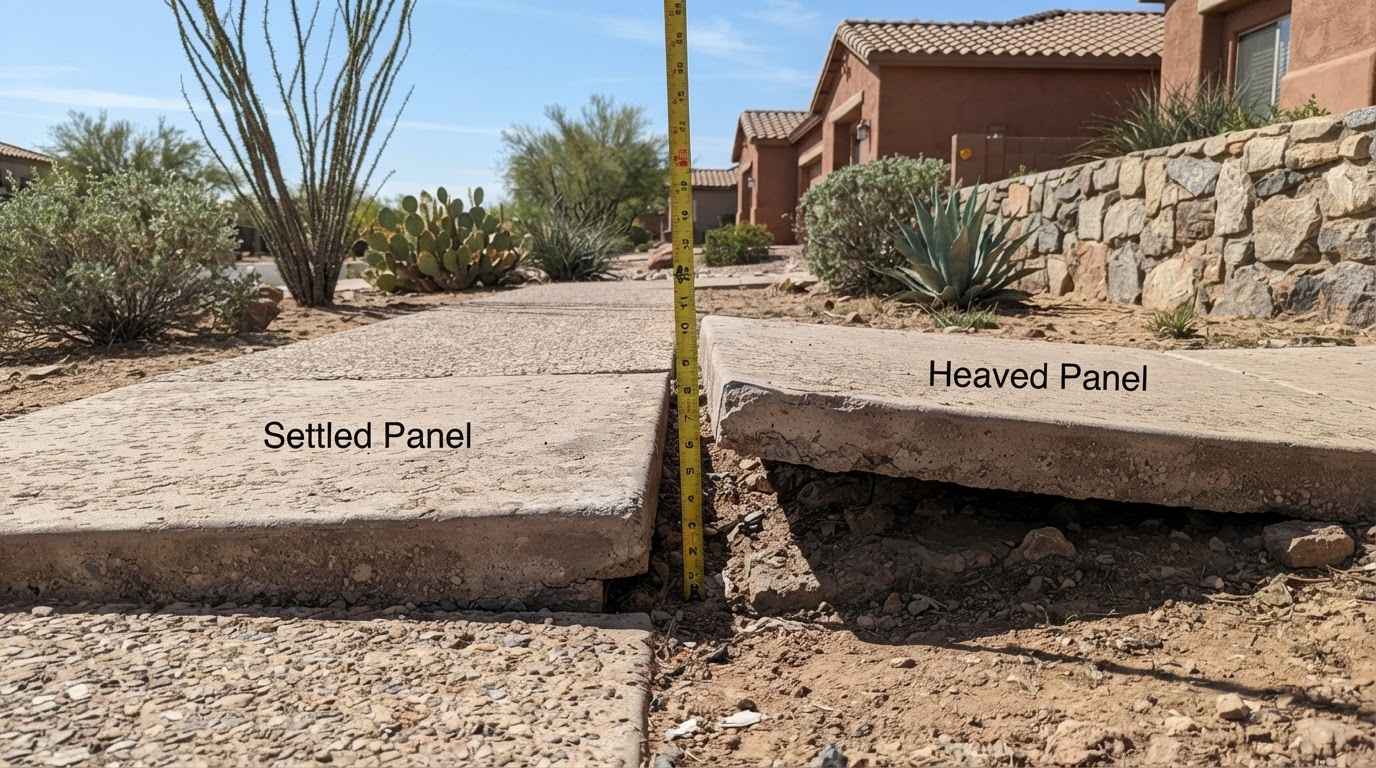
Two concrete panels for comparison: one settled-low panel that could be leveled and one heaved raised panel pushed upward

Replacement Guidance for Non-Liftable Panels

Replacement guidance for non-liftable panels helps property owners identify when a trip hazard cannot be corrected by leveling — because the panel has heaved upward, is badly deteriorated, or is root-displaced rather than settled. It applies to panels that are not suitable for lifting from beneath.

The panel is evaluated to determine whether the movement is settlement that leveling can address or heaving, fragmentation, or root displacement that requires a different repair. Where leveling is not appropriate, the guidance explains why replacement or another approach is the better path.

The result is an honest assessment that prevents a leveling attempt on a panel that cannot be corrected that way, so the property owner can pursue the repair that actually addresses the hazard.

What Causes Concrete Trip Hazards in Gilbert?

Trip hazards form when adjacent slabs no longer meet evenly. The type of movement — settlement versus heaving — determines whether leveling can correct the hazard.

One Panel Settles Below Another

When a panel settles and drops below its neighbor, a vertical transition forms at the joint. Settled panels are the most common trip hazard that leveling can correct by raising the lower surface back into alignment.

Roots or Landscaping Affect a Walkway

Tree roots or landscaping can push a panel upward or displace it from below, creating an uneven transition. Root-displaced or heaved panels may need a different repair than leveling, because the concrete has been pushed up rather than settled.

Water Movement and Erosion

Water moving along joints, edges, or downspout discharge can carry soil away from beneath a slab. Erosion removes the support under the concrete and lets the panel drop, creating a transition that may be corrected by leveling.

Variable Soil Compaction

If the subgrade beneath a panel was not uniformly compacted, the soil can settle unevenly and the slab above it follows, creating an elevation difference at the joint. Variable compaction is a common cause of settled panels.

Heaving or Upward Movement

Heaving is upward movement — the concrete is pushed above its neighbor rather than settling below it. Heaved panels cannot be corrected by leveling from beneath and may require replacement or another approach.

Movement at Driveway and Entry Transitions

Settlement and movement often show up first at transitions — where a driveway meets a walkway, or where a path meets an entry slab. These joint locations are where elevation loss becomes most visible and where trip hazards form.

When Should Uneven Concrete Be Evaluated?

These are common signs that uneven concrete should be evaluated for a trip hazard correction. An on-site evaluation determines whether leveling is the right fit — these symptoms are not a remote diagnosis.

Visible Vertical Transition

A visible height difference at a joint between two slabs is the clearest sign of a trip hazard. Where the lower panel is intact, leveling can reduce the transition.

Repeated Stumbling Point

A location where people repeatedly stumble or catch a foot on a raised lip is a sign of an uneven transition. A transition that catches foot traffic should be evaluated for correction.

Low Sidewalk Panel

A sidewalk panel that has dropped below its neighbor creates a step at the joint. Low panels are the most common trip hazard that leveling can correct.

Changed Driveway or Walkway Relationship

When the height relationship between a driveway and an adjoining walkway has changed, one surface has moved relative to the other. The transition should be evaluated to determine whether leveling can correct it.

Common-Area Slab Settlement

Settled panels in an HOA or commercial common area create trip hazards across shared pedestrian surfaces. Multiple panels can be evaluated and scoped in a single assessment.

Broken or Heaved Slab Requiring Alternative Evaluation

A slab that is badly broken, heaved, or root-displaced may not be a leveling candidate. These panels require an alternative evaluation to determine the right repair path.

Our Concrete Trip Hazard Evaluation and Repair Process

A clear, condition-first process keeps the evaluation straightforward and honest about whether leveling is the right correction.

  1. 1

    Inspect the Uneven Concrete

    The transition is inspected to measure the vertical offset, identify which surface moved, and assess the condition of the affected panels — whether they are intact, cracked, heaved, or deteriorated.

  2. 2

    Identify Which Surface Moved and Why It Matters

    The type of movement — settlement versus heaving, root displacement, or deterioration — is identified because it determines whether leveling can correct the hazard or whether another repair is needed.

  3. 3

    Determine Whether Leveling Is Appropriate

    Based on the movement type and panel condition, the evaluation determines whether the lower panel can be leveled, or whether the panel needs replacement or a different approach. No compliance guarantees are made.

  4. 4

    Perform the Suitable Concrete-Leveling Scope

    Where leveling is appropriate, material is introduced beneath the settled panel to fill the void and raise the concrete back into alignment, with the transition monitored as the material works beneath the slab.

  5. 5

    Review the Transition and Next Steps

    The corrected transition, any remaining hazards, drainage implications, and cleanup are reviewed, and follow-up or next-step guidance is explained. No hazardous DIY drilling or injection is expected of the property owner.

How Much Does Concrete Trip Hazard Repair Cost in Gilbert?

Exact price depends on the specifics of your transitions and panels and is set after an on-site evaluation. Detailed local dollar ranges are not published here because responsible pricing requires inspecting the project. These categories show what drives the cost of trip hazard repair.

Job typeTypical rangeWhat affects price
Single uneven panelProject-specific estimateDriven by the panel dimensions, amount and type of movement, void size, method, access, slab condition, and the number of treatment points. A single settled panel sits at the lower end of the range.
Multiple sidewalk panelsProject-specific estimateDriven by the number of panels, length of the walk, amount of movement, void volume, method, access, roots or landscaping constraints, and the relationship to adjoining surfaces.
Entry or walkway transitionProject-specific estimateDriven by the transition section size, amount of movement, void volume, the relationship to the entry and adjoining walkway, drainage and slope complexity, access, and mobilization.
HOA or common-area evaluation and levelingProject-specific estimateDriven by the number of affected panels and transitions, total area, method, access, multi-area scheduling, phasing, slab condition, and the portions that need replacement rather than leveling.
Commercial pedestrian flatworkProject-specific estimateDriven by the number of transitions, slab count and square footage, method, site access, mobilization, pedestrian and vehicle coordination, phasing, and right-of-way or property responsibility considerations.

Ready to Evaluate Your Uneven Concrete?

Get a clear estimate and honest guidance on whether leveling can correct your trip hazard — or whether the panel needs a different repair.

Call 602-905-1220Or fill out the form →

Request an Estimate

Tell us about your project. We'll follow up with clear pricing and next steps.

The customer/project address for the work.


Consent is optional. You may request an estimate without opting in to text messages.

Can Every Concrete Trip Hazard Be Fixed With Leveling?

No. Leveling is most useful when an otherwise serviceable panel has settled; heaved, severely broken, deteriorated, root-displaced, or jurisdiction-controlled concrete may require another repair path. The type of movement determines whether leveling can correct the hazard.

A settled panel — one that has dropped below its neighbor — can often be leveled by raising the lower surface back into alignment. A heaved panel — one that has been pushed upward — cannot be corrected by lifting from beneath, because the concrete has moved in the wrong direction and the problem is not settlement. Root-displaced panels, badly fragmented concrete, and slabs in a public right-of-way may require replacement, root management, or jurisdictional authorization rather than leveling.

Concrete leveling alone does not automatically make a walkway ADA or code compliant — compliance depends on the overall walkway conditions and the applicable standards for the specific site, which must be evaluated separately. The right approach is to identify which surface moved, why, and whether the panel is a leveling candidate before recommending a correction. No hazardous DIY grinding, drilling, or lifting is expected of the property owner.

What creates a concrete trip hazard?

A concrete trip hazard is created when adjacent slab surfaces no longer meet evenly, producing a vertical transition at a joint or edge where one panel has settled, heaved, or shifted relative to the next. Causes may include settlement, heaving, roots, erosion, compaction changes, moisture, drainage, or movement at joints. The type of movement determines whether leveling can correct the hazard or whether another repair is needed.

Can a sunken sidewalk panel be leveled to reduce an uneven transition?

Yes, a sunken sidewalk panel can often be leveled to reduce an uneven transition when the panel is intact but has settled below its neighbor. Leveling material is introduced beneath the lower panel to fill the void and raise the concrete back into alignment, reducing the vertical transition at the joint. The panel must be sound enough to be lifted as a unit.

Can concrete leveling fix a raised or heaved sidewalk panel?

No, concrete leveling does not fix a raised or heaved sidewalk panel, because heaving means the concrete has been pushed upward — the problem is not settlement that can be corrected by lifting from beneath. A heaved panel may require a different repair approach such as replacement, root management, or evaluation by the appropriate specialist. Leveling is most useful for panels that have settled, not panels that have risen.

Does trip hazard repair automatically make a walkway ADA compliant?

No, concrete leveling alone does not automatically establish ADA or code compliance for a walkway. Applicable measurements, slope requirements, and standards must be evaluated for the specific site to determine compliance, and leveling is one possible correction that may reduce a vertical transition. Compliance depends on the overall walkway conditions and the relevant standards, not on leveling alone.

Can HOA and commercial walkway trip hazards be evaluated?

Yes, HOA and commercial walkway trip hazards can be evaluated to determine whether leveling is an appropriate correction for the affected panels. Multiple panels across a property can be assessed, and the work can be scoped and phased where practical. Panels that are heaved, badly deteriorated, or in a public right-of-way may require a different approach.

Who handles trip hazards in a public right-of-way?

Responsibility for trip hazards in a public right-of-way depends on the specific location and jurisdiction, and authorization may be required before private work can proceed. Public sidewalks may involve municipal responsibility, permits, standards, or authorization that must be confirmed for the project location. The property location should be confirmed before assuming private work can proceed on a right-of-way sidewalk.

How do I request a concrete trip hazard estimate in Gilbert?

You can request a concrete trip hazard estimate in Gilbert by calling 602-905-1220 or by filling out the estimate form on this page. Provide your name, phone number, email, project address, and a brief description of the uneven concrete. A team member will follow up to schedule an on-site evaluation and determine whether leveling or another repair is appropriate.

Request a Concrete Leveling Estimate

Talk to a Gilbert concrete leveling specialist with 10+ years of experience. Insured work, clear pricing, and a straightforward process — no pressure.

602-905-1220

Request an Estimate

Tell us about your project. We'll follow up with clear pricing and next steps.

The customer/project address for the work.


Consent is optional. You may request an estimate without opting in to text messages.