10+ Years ExperienceInsured
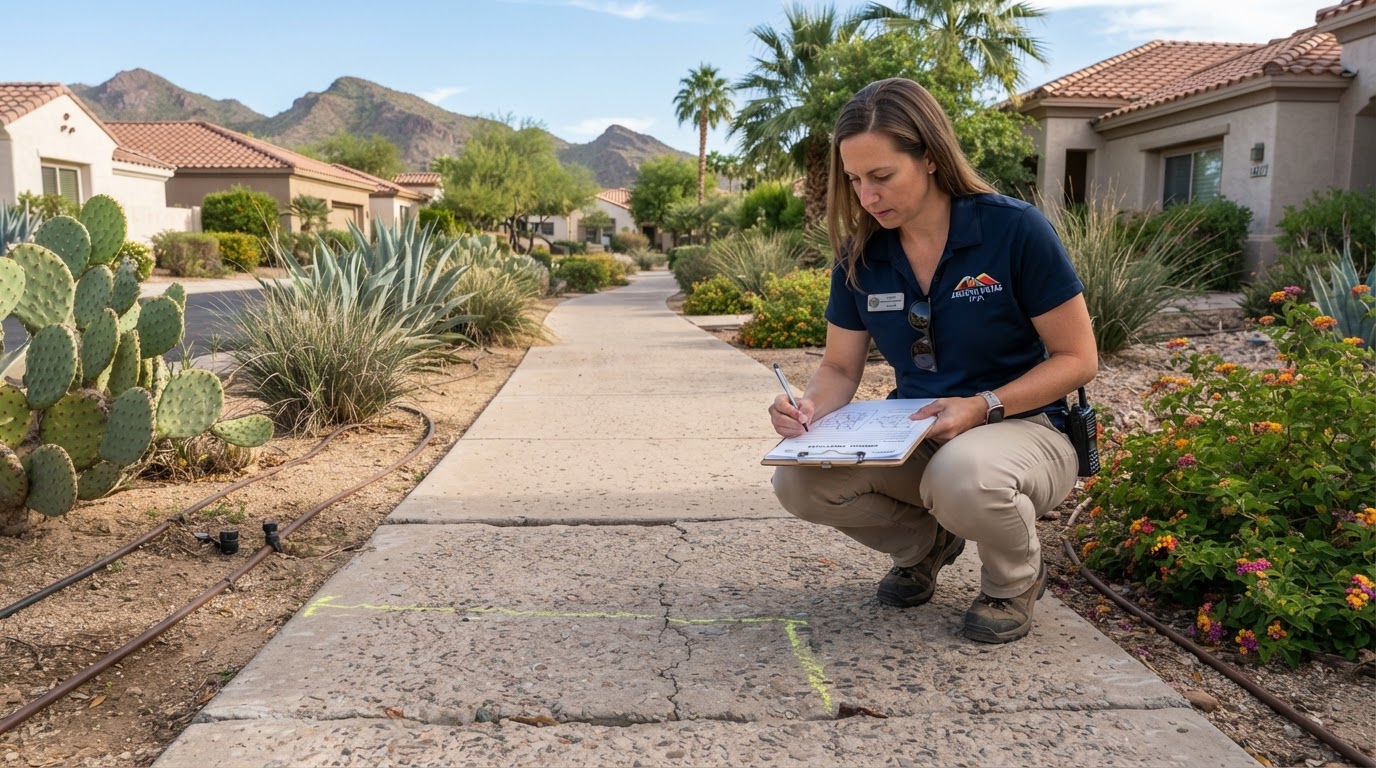
Property manager or technician inspecting multiple concrete walkway panels in a managed Gilbert, Arizona residential community

10+ Years Experience · Insured

HOA & Commercial Concrete Leveling in Gilbert, AZ | 10+ Years Experience

Multi-area concrete leveling for HOAs, multifamily communities, and commercial properties — scoped, prioritized, and phased around site use where practical.

Request an Estimate

Tell us about your project. We'll follow up with clear pricing and next steps.

The customer/project address for the work.


Consent is optional. You may request an estimate without opting in to text messages.

This page targets property managers, HOA boards and managers, multifamily properties, office and retail sites, and other commercial decision-makers who need concrete leveling across one or more affected areas on a managed property. The focus is on scoping, prioritizing, multi-area assessment, pedestrian transitions, access planning, and phased work where practical — the decision-maker priorities that a residential page does not address. Leveling may help preserve suitable existing concrete and reduce disruptive removal and replacement where practical, while severely deteriorated concrete may still need replacement. See the broader commercial concrete leveling category page for the full overview of commercial services.

With 10+ years of experience and insured service, Gilbert Concrete Leveling evaluates managed properties by inspecting the affected slabs and transitions, separating leveling candidates from replacement candidates, and preparing a clear scope and estimate that a board or property manager can act on. We do not claim existing HOA or property-management accounts, do not promise zero downtime, and do not guarantee ADA or code compliance — compliance depends on the overall walkway conditions and applicable standards for the specific site. No procurement certifications, insurance limits, vendor registrations, or licenses are claimed. The goal is a practical, phased plan that reduces trip hazards and preserves suitable concrete across the property.

Why Gilbert HOAs and Property Managers Choose Our Concrete Leveling Approach

Managed properties need more than a single-panel repair — they need a scoped, prioritized plan. Our role is to evaluate the whole property, separate leveling from replacement, and prepare a plan a board or manager can act on.

  • 10+ Years of Experience

    A decade of leveling concrete across Gilbert properties, including multi-area assessments for HOAs, multifamily communities, and commercial sites.

  • Insured

    Gilbert Concrete Leveling is insured for the concrete leveling work we perform on managed properties.

  • Multi-Area Flatwork Evaluation

    The evaluation covers the entire property — sidewalks, walkways, entries, common areas, and pedestrian transitions — not just one isolated panel.

  • Multiple Leveling Methods

    We select between polyjacking, mudjacking, void filling, and stabilization based on what each slab and void condition requires across the property.

  • Scope Prioritization

    Affected areas are prioritized by safety, trip-hazard severity, and property use so the highest-priority transitions are addressed first.

  • Clear Repair-vs-Replacement Recommendations

    Each slab is identified as a leveling candidate or a replacement candidate, so only the concrete that needs replacement comes out.

  • Pedestrian-Transition Awareness

    The evaluation focuses on the transitions where trip hazards form — joints, entries, and walkway intersections — across the managed property.

  • Access and Phasing Considerations

    Work is planned around site use, pedestrian and vehicle access, and phasing where practical to minimize disruption to residents and visitors.

  • Clear Estimates and Communication

    The scope and estimate are laid out plainly so a board or property manager can review, prioritize, and act on the plan.

HOA and Commercial Concrete Leveling Services

Each application below addresses a specific type of managed-property concrete where leveling may be appropriate. The scope is prepared for a board or property manager.

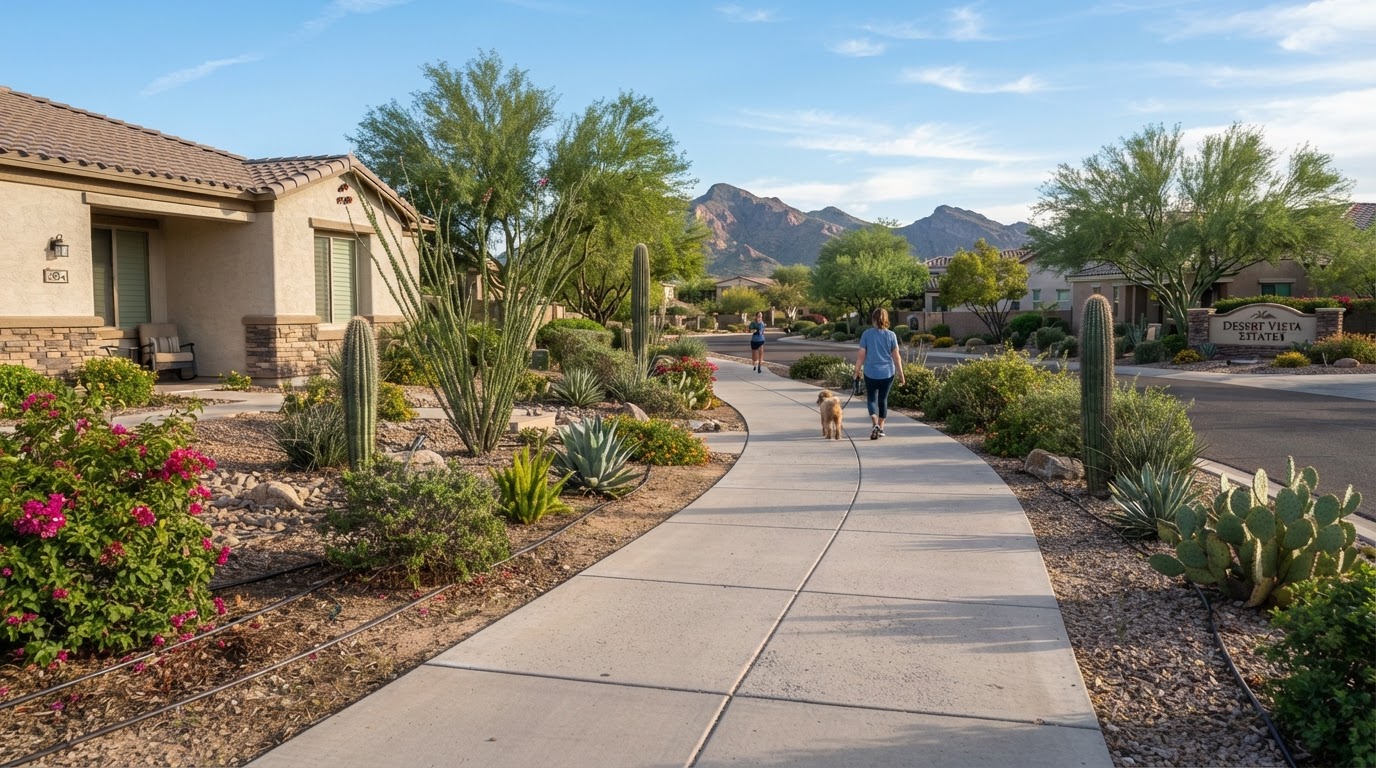
HOA common-area sidewalk panels running through a landscaped residential community in Arizona

HOA Sidewalk and Common-Area Leveling

HOA sidewalk and common-area leveling addresses settled panels across shared pedestrian walkways in a residential community, where multiple panels may have dropped and created trip transitions. It applies to common-area flatwork where the panels are intact but have lost elevation or support.

Leveling material is introduced beneath the affected panels to fill voids and raise the concrete back into alignment, with attention to the shared walkway transitions, access coordination, and the drainage conditions across the common area. The scope separates leveling candidates from panels that need replacement.

The outcome is a safer common-area walkway system with reduced trip transitions across the property, preserving suitable existing concrete and reducing the disruption of full removal and replacement where practical.
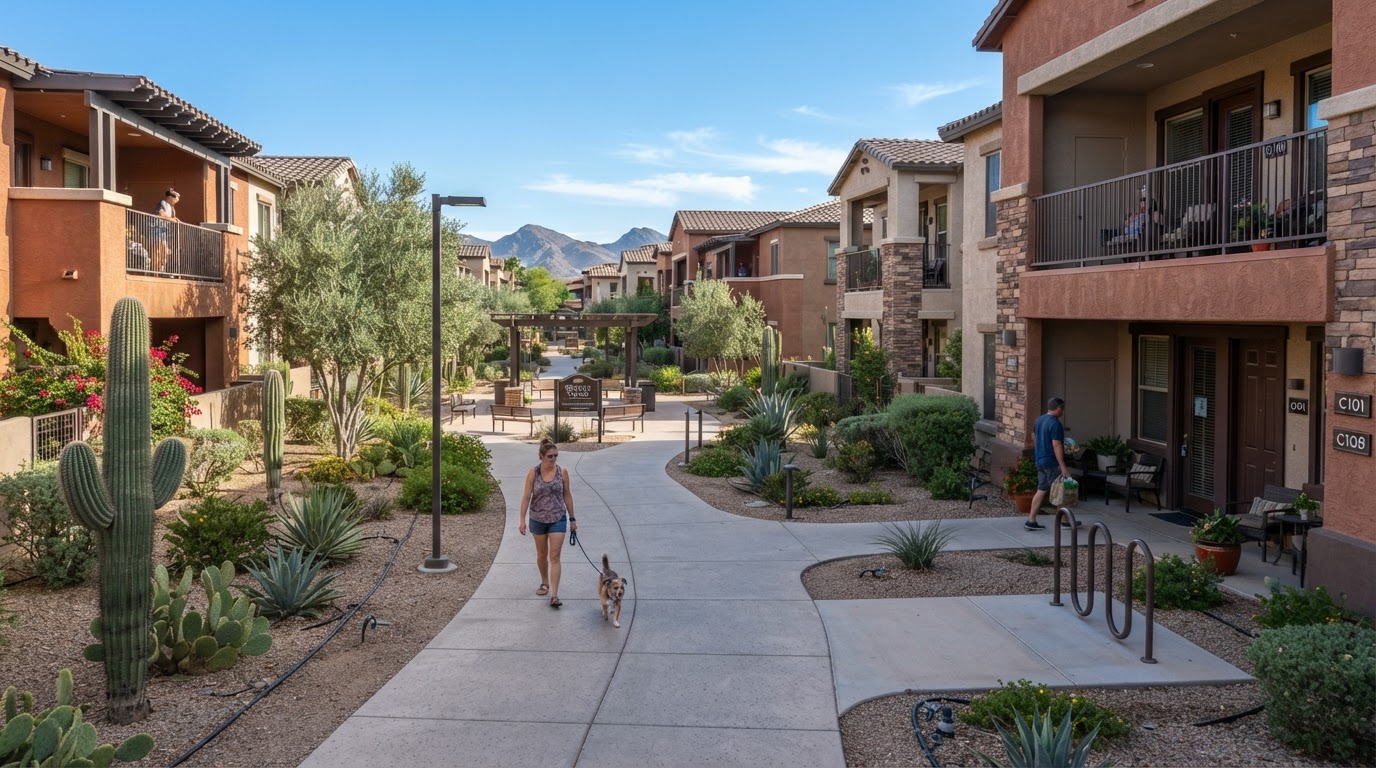
Multifamily apartment community pedestrian walkway concrete flatwork in an Arizona setting

Apartment and Multifamily Walkway Leveling

Apartment and multifamily walkway leveling addresses settled pedestrian walkways, entries, and common flatwork across an apartment community where tenant foot traffic crosses uneven transitions. It applies where the panels are intact but have settled or lost support.

Leveling material is introduced beneath the affected walkway panels to fill voids and raise the concrete back into alignment, with attention to tenant access, courtyard and common flatwork transitions, and site use. The work can be phased to minimize disruption to residents.

The result is a more even walkway system across the multifamily community with reduced trip transitions, preserving suitable existing concrete and planning the work around tenant access where practical.

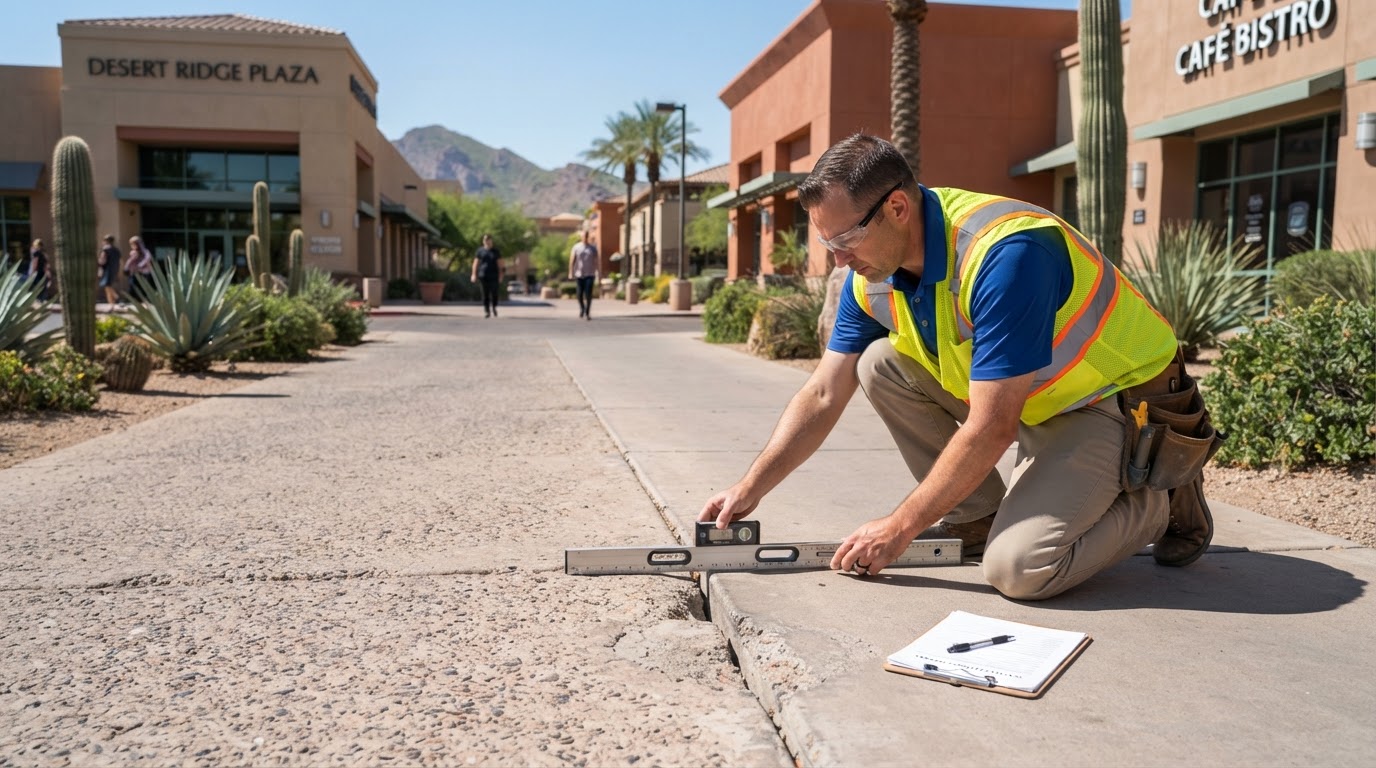
Retail or office building pedestrian concrete walkway being assessed for flatwork transitions

Retail and Office Pedestrian Flatwork Leveling

Retail and office pedestrian flatwork leveling addresses settled walkways, entries, and access areas at commercial properties where customer and employee foot traffic crosses uneven transitions. It applies where the panels are intact but have dropped or lost support.

Leveling material is introduced beneath the affected panels to fill voids and raise the concrete back into alignment, with attention to pedestrian access, site use, and scheduling the work around business hours where practical. The scope is prepared for the property decision-maker.

The outcome is a more even pedestrian surface at the retail or office property with reduced trip transitions, preserving suitable existing concrete and reducing the disruption of removal and replacement where practical.
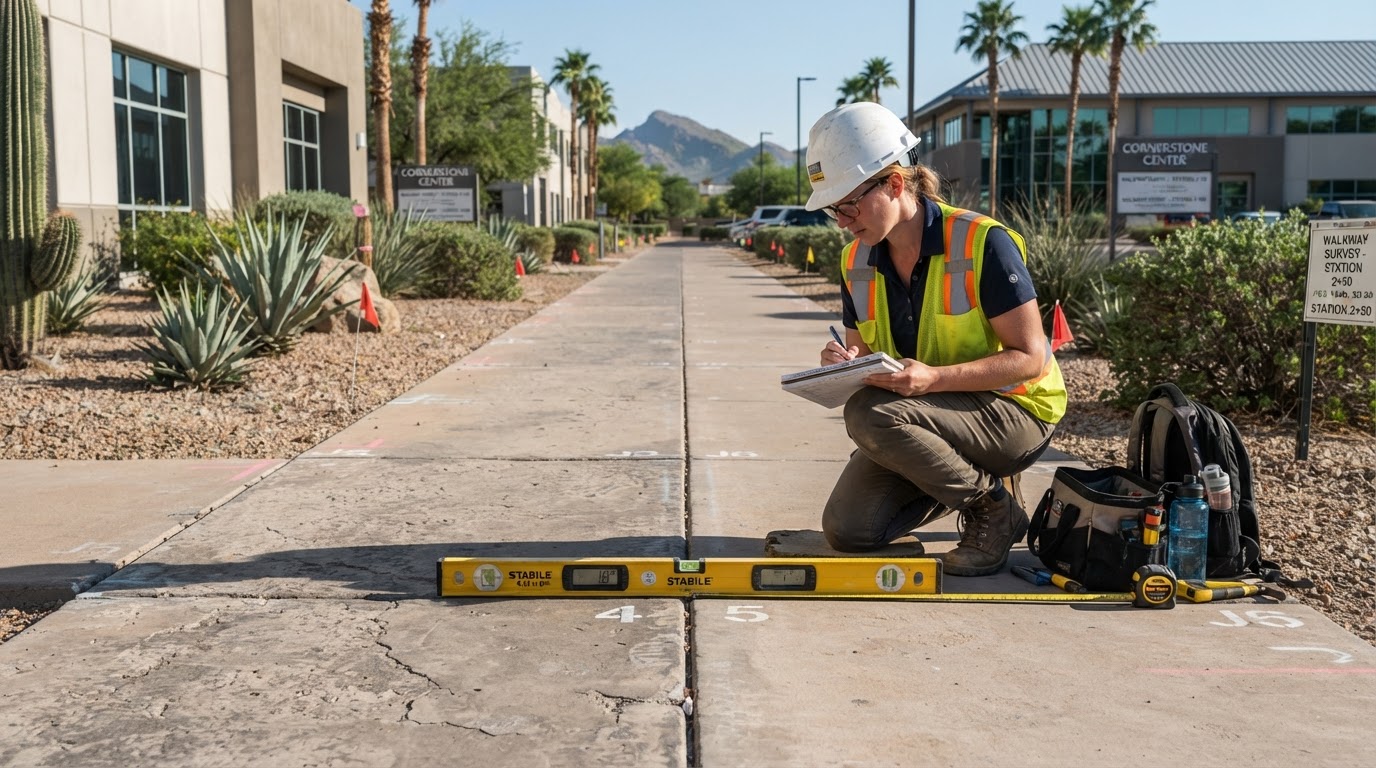
Technician documenting multiple concrete slab elevations with measurement tools along a commercial walkway

Multi-Area Concrete Leveling Assessments

Multi-area concrete leveling assessments evaluate the entire managed property — sidewalks, walkways, entries, common areas, and pedestrian transitions — to identify every affected slab and prioritize the work. It applies to properties with multiple areas of settlement or lost support.

Each affected slab and transition is inspected for settlement, heaving, condition, and support, and a scope is prepared that separates leveling candidates from replacement candidates and prioritizes the highest-safety transitions first. Access and phasing are considered.

The result is a complete, prioritized plan that a board or property manager can review and act on, covering every affected area on the property rather than a single isolated repair.

Commercial flatwork void filling and stabilization context on managed-property concrete

Commercial Void Filling and Slab Stabilization

Commercial void filling and slab stabilization address the open spaces that form beneath managed-property flatwork when soil erodes or settles away from the underside of the concrete. It applies where the support beneath pedestrian surfaces has been lost, whether or not the surface has dropped significantly.

Material — polyurethane foam or cementitious grout — is introduced beneath the affected slabs to fill the voids and re-establish bearing, with attention to the drainage conditions that created the voids and the access constraints of the managed property. Stabilization may be the goal without major lifting.

The outcome is stabilized commercial flatwork with restored support beneath it, reducing the conditions that can lead to further settlement and transitions across the property.

Trip-transition evaluation for managed properties showing uneven pedestrian walkway panels

Trip-Transition Evaluation for Managed Properties

Trip-transition evaluation for managed properties assesses the uneven transitions across a property's pedestrian surfaces to determine which can be leveled and which need another approach. It applies to HOA, multifamily, and commercial walkways with multiple trip hazards.

Each transition is inspected to identify which surface moved, the type of movement, and whether the panel is a leveling candidate. Settled panels are scoped for leveling; heaved, broken, or deteriorated panels are identified for replacement or a different repair.

The result is a clear map of the trip hazards across the property, separating the transitions that leveling can correct from those that need another approach, so the property decision-maker can plan the work.

Concrete Problems We Evaluate on Managed Properties

These are the common concrete problems that prompt HOA, multifamily, and commercial property managers to request a leveling evaluation.

Multiple Settled Sidewalk Panels

When several sidewalk panels across a property have settled below their neighbors, the walkway develops multiple trip transitions. A multi-area evaluation scopes all the affected panels in one assessment.

Uneven Entry and Pedestrian Transitions

Settled slabs at entries, walkway intersections, and pedestrian transitions create trip hazards where foot traffic is heaviest. These high-traffic transitions are often the highest-priority corrections.

Low Concrete Near Drainage Paths

Slabs that have settled along drainage paths or where water collects may have lost support beneath them. Drainage is part of the evaluation because it affects whether the settlement will continue.

Voids or Lost Support Beneath Flatwork

Open spaces beneath pedestrian surfaces indicate that the support has been lost. Void filling and stabilization address that lost support before the slabs drop further.

Mixed Areas Where Some Slabs Can Be Leveled and Others Need Replacement

Most managed properties have a mix of panels — some that are intact and suitable for leveling, and others that are heaved, broken, or deteriorated. The evaluation separates the two so only the slabs that need replacement come out.

How We Scope HOA and Commercial Concrete Leveling

A clear, property-wide process keeps the scope transparent and actionable for a board or property manager.

  1. 1

    Review the Property and Priority Areas

    The property is reviewed with the manager or board to identify the priority areas — the transitions, entries, and walkways where trip hazards are most urgent — before the detailed inspection begins.

  2. 2

    Inspect Affected Slabs and Transitions

    Every affected slab and transition is inspected for settlement, heaving, condition, and support, so the scope covers the entire property rather than a single isolated panel.

  3. 3

    Separate Leveling Candidates From Replacement Candidates

    Each slab is identified as a leveling candidate or a replacement candidate based on its condition and the type of movement, so only the concrete that needs replacement comes out.

  4. 4

    Prepare a Clear Scope and Estimate

    A scope and estimate are prepared that cover every affected area, prioritized by safety and property use, so the board or manager can review and act on the plan.

  5. 5

    Plan Access and Phasing Where Practical

    The work is planned around site use, pedestrian and vehicle access, and phasing where practical to minimize disruption to residents, customers, and employees.

  6. 6

    Complete the Work and Review Remaining Priorities

    The leveling work is performed on the scoped panels, and the completed transitions and any remaining priorities are reviewed so the property can plan the next phase if needed. No hazardous DIY drilling or injection is expected.

How Is HOA and Commercial Concrete Leveling Priced in Gilbert?

Exact price depends on the specifics of your property and is set after an on-site evaluation. Detailed local dollar ranges are not published here because responsible pricing requires inspecting the project. These categories show what drives the cost of HOA and commercial concrete leveling.

Job typeTypical rangeWhat affects price
Small common-area repair scopeProject-specific estimateDriven by the number of affected panels, slab dimensions, lift amount, void volume, method, access, and mobilization. A small isolated scope sits at the lower end of the range.
Multi-panel sidewalk scopeProject-specific estimateDriven by the panel count and square footage, lift amount, void and material volume, method, access, the number of work areas, and the relationship to adjoining surfaces and transitions.
Multifamily walkway levelingProject-specific estimateDriven by the walkway area, panel count, lift amount, void volume, method, site access, mobilization, phasing, pedestrian coordination, and tenant-access planning.
Retail or office flatworkProject-specific estimateDriven by the flatwork area, panel count, lift amount, void volume, method, site access, mobilization, pedestrian and vehicle coordination, scheduling around business hours, and slab condition.
Multi-area void filling or stabilizationProject-specific estimateDriven by the number of affected areas, total void volume, material volume, site access, mobilization, phasing, drainage and landscape constraints, slab condition, and the portions that need replacement rather than stabilization.

Ready to Scope Your Property's Concrete Leveling?

Get a multi-area evaluation, a clear scope, and a prioritized estimate for your Gilbert HOA, multifamily, or commercial property.

Call 602-905-1220Or fill out the form →

Request an Estimate

Tell us about your project. We'll follow up with clear pricing and next steps.

The customer/project address for the work.


Consent is optional. You may request an estimate without opting in to text messages.

Can Larger Properties Phase Concrete Leveling Work?

Many multi-area properties can be evaluated and prioritized in phases when site conditions and access allow, although the appropriate sequence depends on the affected slabs, safety priorities, property use, and repair scope. Phasing lets a property address the highest-priority transitions first and plan the remaining work around site use.

For an HOA, that might mean leveling the most hazardous sidewalk transitions in one phase and planning the remaining common-area panels in a follow-up scope. For a multifamily community, phasing can stagger the work around tenant access so walkways remain usable. For a retail or office property, the work can be scheduled around business hours where practical. Not every project can remain fully accessible during work, and the phasing plan is built around the specific property, its use, and its priorities.

Concrete leveling alone does not automatically make commercial walkways ADA or code compliant — compliance depends on the overall walkway conditions and the applicable standards for the specific site. The goal of phasing is a practical, prioritized plan that reduces trip hazards and preserves suitable concrete across the property without claiming zero downtime or guaranteed compliance. With 10+ years of experience and insured service, Gilbert Concrete Leveling scopes the work so a board or property manager can review, prioritize, and act.

Can an HOA level multiple sidewalk panels in one project?

Yes, an HOA can level multiple sidewalk panels in one project when the affected panels are suitable for leveling and the conditions across the property support a coordinated scope. Multiple settled panels across common-area walkways can be evaluated, prioritized, and scoped together. Panels that are heaved, badly deteriorated, or otherwise unsuitable for lifting are identified separately for replacement or another approach.

Can apartment and multifamily walkways be leveled?

Yes, apartment and multifamily walkways can be leveled where the concrete panels remain suitable for lifting. Settled pedestrian walkways, entries, and common flatwork across a multifamily community can be evaluated and scoped with attention to tenant access and site use. The work can be phased where practical to minimize disruption to residents.

Can commercial concrete leveling be completed in phases?

Yes, many multi-area properties can be evaluated and prioritized in phases when site conditions and access allow, although the appropriate sequence depends on the affected slabs, safety priorities, property use, and repair scope. Phasing lets a property address the highest-priority transitions first and plan the remaining work around site use. Not every project can remain fully accessible during work.

Can uneven pedestrian transitions be corrected without replacing every slab?

Yes, uneven pedestrian transitions can often be corrected by leveling the settled panels without replacing every slab on the property. Leveling raises the dropped panels back into alignment with their neighbors, preserving the existing concrete. Panels that are heaved, badly broken, or deteriorated are identified for replacement rather than leveled, so only the slabs that need replacement come out.

Does concrete leveling automatically make commercial walkways ADA compliant?

No, concrete leveling alone does not automatically make commercial walkways ADA compliant. Compliance depends on the overall walkway conditions — slope, transitions, width, and surface — and the applicable standards for the specific site, which must be evaluated separately. Leveling is one possible correction that may reduce a vertical transition, but it does not establish compliance by itself.

Can voids beneath commercial flatwork be stabilized?

Yes, voids beneath commercial flatwork can be stabilized by introducing material into the open space beneath the slab to fill the void and re-establish bearing. This is useful where the support has been lost beneath pedestrian surfaces on managed properties, whether or not the surface also needs to be raised. The treatment is chosen for the void characteristics and site access.

How do property managers request a concrete leveling estimate in Gilbert?

Property managers can request a concrete leveling estimate in Gilbert by calling 602-905-1220 or by filling out the estimate form on this page. Provide your name, phone number, email, project address, and a brief description of the concrete concerns across the property. A team member will follow up to schedule a multi-area evaluation and prepare a scope and estimate.

Request a Concrete Leveling Estimate

Talk to a Gilbert concrete leveling specialist with 10+ years of experience. Insured work, clear pricing, and a straightforward process — no pressure.

602-905-1220

Request an Estimate

Tell us about your project. We'll follow up with clear pricing and next steps.

The customer/project address for the work.


Consent is optional. You may request an estimate without opting in to text messages.